News
News
Emergency Bed And Rescue Bed: Design, Features, And Clinical Applications
When a patient arrives in the emergency department in critical condition, the bed is not merely furniture — it is an active clinical tool. Emergency beds and rescue beds are engineered for speed, accessibility, and life-support integration. They must allow clinicians to access the patient from multiple angles simultaneously, transition rapidly between positions, and interface seamlessly with emergency medical equipment. The difference between a standard ward bed and a purpose-built rescue bed becomes most apparent in the first minutes of a critical presentation, when seconds determine patient outcomes.
What Defines an Emergency Bed
An emergency bed — also called a rescue bed, crash bed, or emergency room bed — differs from a standard hospital bed in several critical ways:
• Rapid flat positioning: The entire bed surface can be rendered horizontal in under 3 seconds, without sequentially lowering each section. This is essential for initiating CPR or performing emergency intubation.
• Unrestricted patient access: The bed design minimizes structural obstructions around the patient. Side rails collapse fully, foot sections drop away, and the bed height can be set to ultra-low for floor-level resuscitation.
• Heavy-duty castors with central braking: A single pedal locks all four wheels simultaneously — critical when performing chest compressions on a bed that must not move under applied force.
• Radiolucent platform sections: Allow X-ray imaging of the torso without transferring the patient off the bed, which is unacceptable in hemodynamically unstable patients.
These features are not optional extras. They are core engineering requirements dictated by emergency medicine workflow.
Hydraulic vs Electric Lift Systems
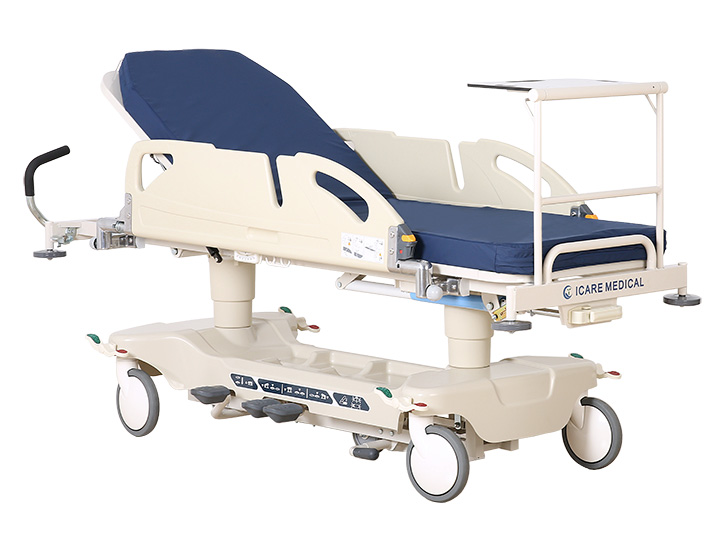
Emergency beds use two primary elevation mechanisms, each with distinct advantages.
Hydraulic Lift Systems
Hydraulic systems use a foot pump or manual lever to raise and lower the bed platform via hydraulic cylinders. The operator stands on a pedal repeatedly to generate pressure that lifts the bed.
Advantages:
• No electrical power required — the bed functions during power failures
• Robust and simple mechanism with low failure rates
• Fast manual height adjustment when the operator is experienced
• Lower initial cost
Disadvantages:
• Requires physical effort from staff
• Less precise height control
• Cannot maintain automated position presets
• Foot pump operation is impractical during active resuscitation
Electric Lift Systems
Electric systems use motorized actuators controlled by push buttons or pendant controls. Height adjustment, backrest articulation, and Trendelenburg positioning are all motor-driven.
Advantages:
• Single-touch operation — one person can adjust the bed during a procedure
• Precise, repeatable positioning
• Automated programs (e.g., CPR flat position, Trendelenburg)
• Integration with bed exit alarms and position sensors
• Battery backup capability for power failure scenarios
Disadvantages:
• Higher initial cost
• Requires electrical infrastructure
• Motor and control board maintenance over the product lifecycle
In modern emergency departments, electric lift systems have become the standard. The ability to drop the bed to flat with a single button press — while simultaneously managing the patient's airway — justifies the investment. ICARE's CC-800 and CC-806 emergency beds feature electric actuation systems designed for the demanding environment of emergency and critical care departments.
Core Features of Emergency and Rescue Beds
Central Locking System
A central braking pedal engages wheel locks on all four castors simultaneously. This is not a convenience feature — it is a safety imperative. During CPR, a bed with unlocked wheels shifts under compression force, reducing compression depth and effectiveness. Studies have shown that ineffective chest compressions on a mobile bed reduce cerebral perfusion pressure by 20-30%.
X-Ray Transparent Cassette Tray
Emergency patients frequently require immediate radiological assessment — chest X-ray for pneumothorax, abdominal X-ray for bowel obstruction, or pelvic X-ray for trauma. A radiolucent cassette tray built into the bed platform allows the imaging cassette to slide beneath the patient without any transfer. This eliminates the risk of dislodging IV lines, endotracheal tubes, or chest drains during transfer.
Trendelenburg and Reverse Trendelenburg
Emergency beds must support rapid Trendelenburg positioning for hypotensive patients and reverse Trendelenburg for those with respiratory distress. The mechanism must be fast — typically achieving full tilt within 8-10 seconds — and stable under load.
CPR Quick-Release
The CPR release mechanism drops the back section to flat instantly. On ICARE CC-800 and CC-806 models, this is achieved through a single lever or button that disengages all articulated sections and returns the entire platform to horizontal within 2-3 seconds.
Height Range
Emergency beds require a wider height range than standard ward beds:
• Ultra-low position (350-400mm): For patient loading from floor level and fall prevention
• Standard position (550-650mm): For nursing care and assessment
• High position (800-850mm): For procedural access and physician examination
The full range must be traversable in under 30 seconds at maximum speed.
Emergency Department Configuration Standards
An emergency department bed bay requires more than just the bed itself. A properly configured resuscitation bay includes:
The bed: A 5-function or 7-function emergency bed with electric height, Trendelenburg, and CPR release capabilities. The bed should be positioned with access on at least three sides for simultaneous clinician access.
Overhead equipment boom: Ceiling-mounted rails carrying power outlets, medical gas connections (oxygen, air, vacuum), and monitor mounting arms. This keeps cables off the floor and provides flexibility in equipment positioning.
Crash cart positioning: The defibrillator and emergency medication cart must be within arm's reach of the bed head — typically on the patient's right side.
Monitoring integration: The bed should have standardized mounting points for patient monitors, allowing the display to be visible from multiple positions around the bed.
Suction and airway equipment: Mounted at the head of the bed for immediate access during airway management.
Choosing Between Hydraulic and Electric: A Practical Framework
The choice between hydraulic and electric lift is not purely a cost calculation. Emergency department administrators should consider several operational factors. Staff-to-patient ratios determine how often a single nurse must manage bed adjustments alone — electric systems eliminate the need for a second staff member to operate a foot pump. Patient acuity trends matter: a trauma center receiving high volumes of critical arrivals will benefit more from the instantaneous positioning of electric systems than from the reliability-but-effort trade-off of hydraulic units.
Power reliability in the facility also plays a role. Hospitals with robust backup generator systems and uninterruptible power supply can confidently specify electric beds. Facilities in regions with frequent power outages may benefit from the hydraulic option — or from electric beds equipped with battery backup modules.
ICU Rescue Applications
While ICU beds and emergency beds share many features, ICU rescue scenarios present unique demands:
Prolonged immobilization: ICU patients may remain on the same bed for days or weeks. The bed must support continuous pressure redistribution through compatibility with alternating-pressure mattresses and lateral rotation systems.
Multi-organ support: An ICU bed may simultaneously support a ventilator circuit, four or more infusion pumps, a hemodynamic monitoring system, a continuous renal replacement therapy machine, and an intra-aortic balloon pump. The frame must accommodate all of these without cable entanglement or structural interference.
Daily weighing: Fluid balance management in critically ill patients requires accurate daily weights. Integrated bed scales eliminate the need to transfer the patient to a separate scale.
Emergency extraction: If the patient deteriorates unexpectedly, the bed must return to flat and lower to its lowest position rapidly for emergency intubation or open cardiac massage.
ICARE designs its CC-806 emergency bed to meet these ICU rescue requirements, with the structural capacity, accessory mounting options, and rapid-positioning capabilities that critical care demands.
Ambulance and Patient Transfer Compatibility
Emergency beds are not confined to the hospital. Pre-hospital and inter-facility transport requires stretchers and transfer beds that interface with both ambulances and hospital bed systems.
Key compatibility considerations:
• Cot fastener systems: The bed or stretcher must lock into the ambulance cot fastener, preventing movement during transport
• Height matching: When transferring from ambulance stretcher to ED bed, the two surfaces must be at identical heights to enable smooth lateral transfer
• Mattress continuity: The transfer should not require moving the patient between mattresses — reducing pain, dislodgement risk, and contamination
ICARE's CA-800, CA-801, and CA-802 transfer bed series addresses inter-department patient movement, with designs optimized for smooth transitions between clinical areas.
ICARE Emergency and Rescue Bed Product Line
ICARE (Wuxi Icare Medical Technology Co., Ltd.) manufactures emergency and rescue beds designed for the demanding environment of emergency departments, ICUs, and trauma centers:
CC-800 Emergency Bed
• Multi-function electric adjustment with rapid CPR flat positioning
• Central locking castor system for resuscitation stability
• X-ray transparent sections for in-bed imaging
• Full height range from ultra-low to high position
• Compatible with ICU-grade accessory configurations
CC-806 Advanced Rescue Bed
• Enhanced version with extended height range and 5-function articulation
• Optimized for emergency department and ICU crossover use
• Rapid Trendelenburg and reverse Trendelenburg capability
• Integrated accessory rails for monitoring and life-support equipment
• ISO 13485 certified manufacturing quality
All ICARE emergency beds are manufactured in the company's 5,000㎡ facility in Wuxi, China, under rigorous quality control standards. The 55+ professional team ensures every unit meets international specifications before shipment, with standardized spare parts available for global after-sales support.
Recommended News
-
Hospital lift bed selection and usage scenarios
-
Process analysis and practical skills of ward nursing from admission to rehabilitation
-
Functional characteristics and selection of medical diagnosis and treatment examination bed
-
Rehabilitation bed: the key to improving the quality of care for long-term bedridden patients
-
Smart elderly care technology empowers and opens up a new era of elderly care services
-
Function analysis and selection precautions of electric smart bed
-
Guidelines for selecting rehabilitation equipment and analysis of common types
-
Function analysis and selection skills of companion bed
-
New intelligent and community-based development of home-based elderly care
◇◇ Related Content ◇◇
- How Do I Verify The Hospital Bed Factory Before Ordering?
- How Do I Compete With Direct Manufacturer Sales As A Hospital Bed Distributor?
- How Do I Verify The Factory Is Real Before Ordering Hospital Beds?
- What Documents Are Required For Hospital Bed Government Tenders?
- Hospital Bed Government Tender For 200 Beds (Full Guide)
- How Much Does OEM Mold Setup Cost For Hospital Beds?
- Emergency Hospital Bed Order: What "30-Day Delivery" Really Means
- How Long Does OEM Hospital Bed Production Take?
- Hospital Bed Spare Parts Planning: What To Stock For A 50-Bed Fleet
◇◇ Related Products ◇◇