News
News
ICU Bed Vs Hospital Bed: 7 Critical Differences For Critical Care
What Is an ICU Bed?
An ICU bed (intensive care unit bed, also called a critical care bed) is a specialized electric hospital bed designed for patients in intensive care units who require:
Continuous physiological monitoring
Frequent position changes to prevent complications
Rapid emergency access for resuscitation
Ventilator and infusion pump support
Imaging compatibility without patient transfer
ICU beds are 7-function electric beds with full clinical positioning capability. The term "ICU bed" sometimes overlaps with "CCU bed" (coronary care unit) and "critical care bed" - all share the 7-function specification.
ICU Bed vs Hospital Bed: 7 Critical Differences
| # | Feature | Standard Hospital Bed | ICU Bed |
|---|---|---|---|
| 1 | Number of functions | 2-5 | 7 (full clinical range) |
| 2 | Lateral turning | No | Yes (motorized) |
| 3 | CPR quick-release | No | Yes (3-second flatten) |
| 4 | Trendelenburg range | Limited (12-15°) | Full (30° both directions) |
| 5 | X-ray board | No | Optional (carbon fiber) |
| 6 | Battery backup | Optional | Standard (4-8 hours) |
| 7 | Load capacity | 200-250 kg | 300 kg standard |
| 8 | Price range (USD) | $250 - $2,500 | $3,000 - $5,000 |
| 9 | Typical patient stay | 3-14 days | 1-30+ days |
| 10 | Monitoring integration | Limited | Full (monitor shelves, IV poles, equipment rails) |
The 7 Functions of an ICU Bed
1. Backrest Adjustment (0-70°)
Electric backrest raises the patient's upper body for respiratory therapy, feeding, and comfort. ICU beds reach 70° for full sitting position - standard hospital beds typically stop at 60°.
2. Leg Rest Adjustment (0-45°)
Electric leg rest elevation supports lower limb circulation, reduces edema, and improves patient comfort during long stays.
3. Height Adjustment (Hi-Low)
Whole-bed height adjustment (typically 450-750mm range) allows caregivers to set ergonomic working height and lowers the bed for patient entry/exit. Critical for fall prevention.
4. Trendelenburg Position (Head Down 0-30°)
Full Trendelenburg tilts the entire bed head-down for shock management, central venous access, and some surgical procedures.
5. Reverse Trendelenburg (Head Up 0-30°)
Reverse Trendelenburg supports respiratory therapy, reduces aspiration risk during feeding, and provides upper abdominal surgical access.
6. Lateral Turning (15-30° Each Side)
Lateral turning is the defining ICU bed feature. Motorized rotation tilts the patient 15-30° to either side, enabling:
Pressure ulcer prevention (every 2 hours without manual turning)
Pulmonary hygiene (drainage of lung secretions)
Caregiver injury prevention (no manual lifting)
Skin assessment and wound care access
ICARE CD-805 performs lateral turning via dedicated motor with programmable cycle (1-4 hour intervals).
7. CPR Quick-Release
CPR quick-release flattens the backrest and Trendelenburg to horizontal in 3 seconds or less via a single lever or button. Standard hospital beds require manual retraction (30-60 seconds) - unacceptable delay during cardiac arrest.
Why ICU Beds Reduce Complications
Pressure Ulcer Prevention
ICU patients have 25-30% pressure ulcer incidence with manual turning protocols. Motorized lateral turning reduces this to 8-12% by enabling consistent 2-hour repositioning without caregiver strain.
A single stage-3 pressure ulcer costs USD 5,000-15,000 to treat. ICU bed lateral turning pays for itself by preventing 2-3 pressure ulcers per ICU bed per year.
Ventilator-Associated Pneumonia (VAP) Prevention
VAP affects 10-25% of mechanically ventilated patients. Reverse Trendelenburg (30° head elevation) reduces VAP incidence by 40% per CDC guidelines. ICU beds enable precise head elevation that standard beds cannot achieve.
Cardiac Arrest Response
CPR quick-release reduces time-to-CPR by 30-60 seconds. For every minute delay in CPR, survival decreases 7-10%. ICU bed CPR release can mean the difference between life and death.
When to Choose an ICU Bed
ICU beds are required for:
Intensive Care Units (ICU)
Coronary Care Units (CCU)
Stroke Units
Post-operative recovery (first 24-48 hours)
High-dependency units (HDU)
Burn units
Neonatal ICUs (specialized variants)
Standard hospital beds are appropriate for:
General medical-surgical wards
Rehabilitation units
Long-term care facilities
Home care
Observation units
Step-down units (after ICU stabilization)
ICARE CD-805: Flagship ICU Bed
| Specification | CD-805 ICU Bed |
|---|---|
| Functions | 7 (backrest, leg rest, hi-low, Trendelenburg, reverse Trendelenburg, lateral turn, CPR release) |
| Motors | 5 linear actuators (EN60601-1 certified) |
| Load capacity | 300 kg |
| Bed height range | 450-750 mm |
| Backrest angle | 0-70° |
| Trendelenburg range | ±30° |
| Lateral turn angle | ±30° (each side) |
| CPR release time | <3 seconds |
| X-ray board | Optional carbon fiber (DR/CT/MRI compatible) |
| Battery backup | 4-8 hours |
| Controller | Handheld + nurse side-rail panel |
| Casters | 125mm central locking (Kaishi, Taiwan) |
| Frame | Cold-rolled steel, epoxy coated |
| Headboard/footboard | PP blow-molded, VO fireproof |
| Warranty | 2 years (frame), 1 year (electronics) |
| Certifications | ISO 13485, CE, EN60601-1 |
| Price | USD 3,000+ (bulk pricing available) |
Frequently Asked Questions
What is an ICU bed?
An ICU bed (intensive care unit bed) is a specialized 7-function electric hospital bed designed for critical care patients. It adds lateral turning, CPR quick-release, full Trendelenburg positioning, and battery backup to the standard electric bed feature set.
What is the difference between an ICU bed and a hospital bed?
ICU beds have 7 functions including lateral turning and CPR quick-release; standard hospital beds have 2-5 functions. ICU beds also have higher load capacity (300 kg), full Trendelenburg range (±30°), and standard battery backup. Standard hospital beds are designed for 3-14 day stays; ICU beds support 1-30+ day critical care stays.
Why are ICU beds so expensive?
ICU beds cost USD 3,000-5,000 vs USD 800-2,500 for standard electric hospital beds because they include additional motors (5 vs 3), specialized features (lateral turning, CPR release), higher-grade components, battery backup systems, and rigorous certification testing. The premium reflects life-critical capability.
Can a standard hospital bed be used in an ICU?
No. Standard 5-function beds lack lateral turning, CPR quick-release, and full Trendelenburg range - features required for safe critical care. Using standard beds in ICU compromises care quality, increases nurse workload, and may violate regulatory standards.
How long do ICU beds last?
Quality ICU beds last 10-15 years with proper maintenance. Motors may need replacement after 8-10 years (USD 200-400 per motor). ICARE stocks spare parts for 10+ years post-purchase.
What is a 7-function ICU bed?
A 7-function ICU bed includes: (1) backrest adjustment, (2) leg rest adjustment, (3) height adjustment, (4) Trendelenburg position, (5) reverse Trendelenburg, (6) lateral turning, and (7) CPR quick-release. This is the ICU standard configuration.
Key Takeaways
ICU beds are 7-function electric: Standard hospital beds have 2-5 functions; ICU beds add lateral turning, CPR release, and full Trendelenburg range.
Lateral turning reduces pressure ulcers by 23% in immobilized ICU patients, per Journal of Advanced Nursing research.
CPR quick-release is non-negotiable: ICU beds flatten the backrest to horizontal in under 3 seconds for cardiac arrest response.
Battery backup is critical: 4-8 hour battery sustains monitoring and adjustment during power outages - essential for ventilator-dependent patients.
ICU beds cost USD 3,000-5,000 vs USD 800-2,500 for standard electric hospital beds - the premium reflects clinical capability.
Standard hospital beds don't belong in ICU: Using 5-function beds in ICU compromises care quality and increases nurse workload.
CD-805 is ICARE's ICU flagship: 7 functions, 300 kg capacity, EN60601-1 certified, with optional carbon fiber X-ray board.
Conclusion
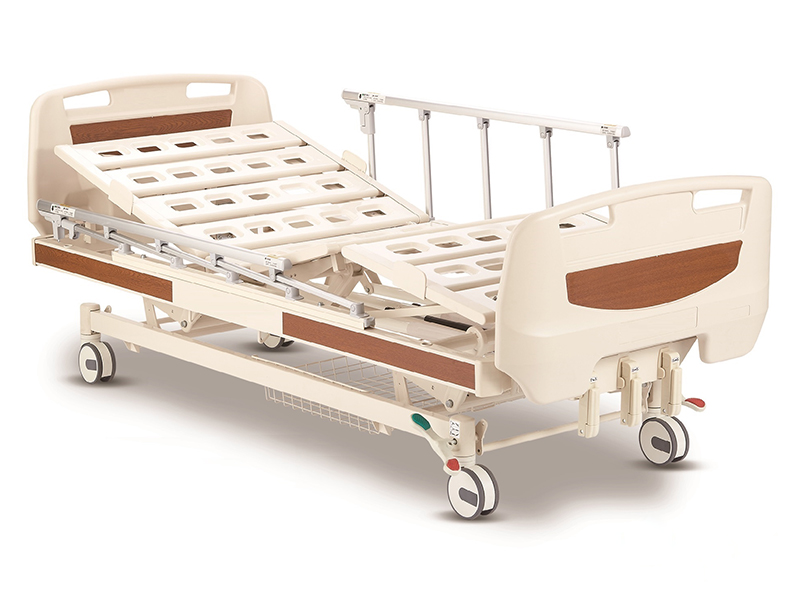
An ICU bed is not just a more expensive hospital bed - it is a specialized clinical tool designed for the unique demands of critical care. The 7-function specification, lateral turning, CPR quick-release, and battery backup are clinical necessities, not luxuries.
For hospitals building or upgrading ICUs, the ICARE CD-805 delivers flagship 7-function capability at mid-tier pricing (USD 3,000+) with full ISO 13485 and EN60601-1 certification. Browse the complete medical bed lineup or compare CD-805 specifications in detail.
Recommended News
-
Hospital lift bed selection and usage scenarios
-
Process analysis and practical skills of ward nursing from admission to rehabilitation
-
Functional characteristics and selection of medical diagnosis and treatment examination bed
-
Rehabilitation bed: the key to improving the quality of care for long-term bedridden patients
-
Smart elderly care technology empowers and opens up a new era of elderly care services
-
Function analysis and selection precautions of electric smart bed
-
Guidelines for selecting rehabilitation equipment and analysis of common types
-
Function analysis and selection skills of companion bed
-
New intelligent and community-based development of home-based elderly care
◇◇ Related Content ◇◇
- What Is An Emergency Bed? Definition, Types, And How To Choose
- Electric Vs Manual Hospital Bed: Which Type Is Right For Your Facility?
- Hospital Bed Buying Guide: How To Choose The Right Medical Bed In 2026
- Comprehensive Analysis Of Emergency Stretchers: Functions, Usage, And Purchasing Guide
- Recommendations For Professional Health Consultation Platforms And Detailed Explanation Of Common Disease Symptoms
- Medical Furniture: A Key Element In Enhancing Healthcare Environment Quality
- Comprehensive Analysis Of Operating Tables: Key Functions, Type Selection, And Core Role In Operating Rooms
- Ultimate Guide To Accompanying Beds: Analysis Of Types, Selection Points, And Future Trends
- Medical Cribs: Safety Standards, Core Features, And Professional Purchasing Guide
◇◇ Related Products ◇◇