News
News
Hospital Bed Buying Guide: How To Choose The Right Medical Bed In 2026
Why Choosing the Right Hospital Bed Matters
A hospital bed is one of the most significant capital investments for any healthcare facility - typically 10-30% of total medical equipment budget. The wrong choice can lead to caregiver injuries, pressure ulcers in patients, regulatory compliance issues, and costly replacements within 5 years.
According to the WHO, pressure ulcers affect 10-25% of hospitalized patients, with inadequate bed positioning contributing to 30% of cases. The right hospital bed with proper functions can reduce pressure ulcer incidence by 23% (per Journal of Advanced Nursing research).
6 Key Factors to Consider When Buying a Hospital Bed
1. Patient Population and Care Duration
The first question is: who will use this bed and for how long?
Acute care (1-7 days): Emergency rooms, post-operative recovery - prioritize emergency beds or transfer beds with mobility and imaging compatibility
Sub-acute care (1-4 weeks): General wards, rehabilitation - 5-function electric beds provide clinical versatility
Long-term care (months to years): Nursing facilities, home care - nursing beds with pressure ulcer prevention features
2. Clinical Setting
Different departments require different bed features:
| Setting | Recommended Bed | Key Features |
|---|---|---|
| ICU | 7-function electric (CD-805) | Lateral turning, CPR, Trendelenburg |
| ER | Hydraulic emergency bed (CC-806) | X-ray board, mobility, 300kg capacity |
| General Ward | 5-function electric (CD-804) | Backrest, legs, height, Trendelenburg |
| Long-term Care | Multi-function nursing bed | Turning, toilet, side rails |
| Home Care | Electric nursing bed (mid-range) | Quiet motors, low height, toilet option |
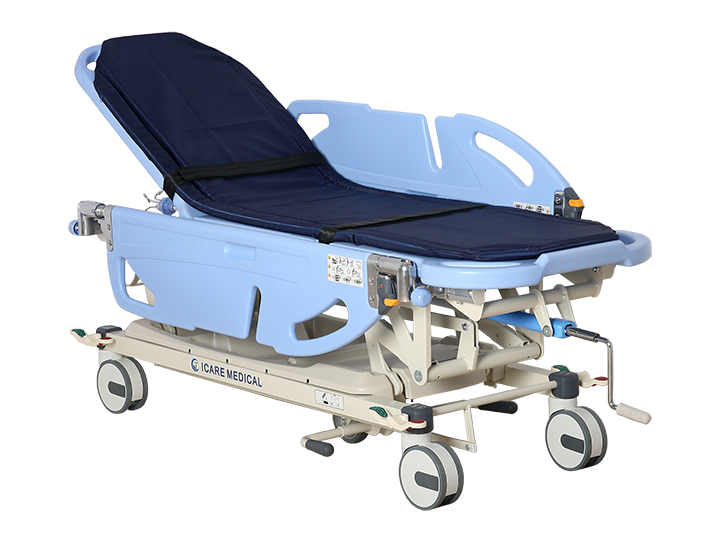
| Ambulance | Mobile transport (CA-807) | Vehicle mount, X-ray board |
3. Manual vs Electric Hospital Bed
Manual Hospital Beds (USD 250-400):
Pros: Lower cost, no electricity required, simpler maintenance
Cons: Caregiver physical strain, slower adjustments, less clinical versatility
Best for: Low-budget clinics, developing markets, stable patients
Electric Hospital Beds (USD 800+):
Pros: 60% reduction in caregiver strain, precise positioning, pressure ulcer prevention
Cons: Higher initial cost, requires power supply, more complex maintenance
Best for: Modern hospitals, ICU, patients needing frequent adjustments
4. Number of Functions
Hospital bed functions determine clinical versatility:
2-Function Manual: Backrest and leg rest adjustment only (most basic)
3-Function Electric: + Height adjustment (mid-range, suitable for general wards)
5-Function Electric: + Trendelenburg and Reverse Trendelenburg (ICU standard)
7-Function Electric: + Lateral turning and CPR quick-release (advanced ICU)
For most hospitals, a 5-function electric bed covers 90% of clinical scenarios. For dedicated ICU beds, the 7-function configuration is recommended.
5. Load Capacity and Patient Demographics
Standard hospital beds support 200-250 kg. For bariatric populations (15-20% of patients in many regions), choose 300 kg+ capacity models. ICARE flagship emergency and ICU beds all support 300 kg.
Bariatric considerations:
Reinforced frame (tested to 1.5x rated capacity)
Wider bed board (1000mm vs standard 840mm)
Higher-powered motors
Reinforced casters
6. Certification and Quality Standards
Must-have certifications:
ISO 13485: Medical Device Quality Management System (mandatory for serious manufacturers)
CE Mark: Required for European distribution
EN60601-1: Medical electrical equipment safety (for electric beds)
UL Listing: Required for North American markets (some manufacturers)
ICARE hospital beds carry all four certifications, manufactured under ISO 13485:2016 quality management.
Hospital Bed Price Comparison (2026)
| Type | Price Range (USD) | Best For |
|---|---|---|
| Manual hospital bed | $250 - $400 | General wards, developing markets |
| 3-function electric | $800 - $1,200 | Nursing homes, basic wards |
| 5-function electric | $1,500 - $2,500 | ICU, CCU, post-op |
| 7-function ICU bed | $3,000 - $5,000 | Critical care, advanced ICU |
| Emergency bed | $1,800 - $4,500 | ER, ambulance, OR |
| Nursing bed | $600 - $3,500 | Home care, elderly care |
| Transfer bed | $1,200 - $4,000 | Hospital transport |
Bulk pricing (10+ units) typically offers 15-30% discount. Container-load orders (50+ units) can negotiate up to 40% discount.
Hospital Bed Buying Decision Flowchart
Patient acuity level?
├─ Acute/Critical → ICU/ER → 7-function electric or emergency bed
├─ Sub-acute → Ward/Rehab → 5-function electric
├─ Long-term → Nursing facility → Multi-function nursing bed
└─ Home care → Adjustable home bed → Nursing bed
Budget per unit?
├─ < $500 → Manual bed
├─ $500-$1,500 → 3-function electric
├─ $1,500-$3,000 → 5-function electric
└─ $3,000+ → 7-function ICU or specialty
Patient weight?
├─ < 200 kg → Standard bed (200-250 kg capacity)
└─ > 200 kg → Bariatric bed (300+ kg capacity)
H2: Top Hospital Bed Manufacturers in 2026
The global hospital bed market is dominated by a few key players:
Premium Tier (USD 5,000-20,000):
Hillrom (Baxter) - USA
Stryker - USA
Linet - Czech Republic
Arjo - Sweden
Mid Tier (USD 2,000-5,000):
ICARE Medical - China (ISO 13485, 80+ countries)
Saikang Medical - China
Jiaxing Falla - China
Hopeful Medical - China
Value Tier (USD 250-2,000):
Various regional manufacturers
ICARE stands out in the mid tier with 20+ years experience, ISO 13485 certification, and global distribution.
Frequently Asked Questions
How much does a hospital bed cost in 2026?
Hospital bed prices range from USD 250 for manual ward beds to USD 20,000 for premium ICU beds from Hillrom or Stryker. Mid-range electric beds from ICARE cost USD 800-5,000.
What is the most common hospital bed?
The most common hospital bed globally is the 5-function electric bed, suitable for 80% of clinical scenarios. ICARE''s CD-803 and CD-804 are popular examples.
How long do hospital beds last?
Quality hospital beds last 10-15 years with proper maintenance. ICARE beds come with 2-year warranty and have spare parts available for 10+ years.
Are used hospital beds worth buying?
Used hospital beds save 40-60% on cost but carry risks: unknown maintenance history, no warranty, potential regulatory issues. For new facilities, new beds with warranty are recommended.
Key Takeaways
Manual vs Electric: Manual beds (USD 250-400) suit low-budget clinics and stable patients; electric beds (USD 800+) reduce caregiver strain by 60% and prevent pressure ulcers.
3-Function vs 5-Function vs 7-Function: 5-function covers 90% of clinical needs; 7-function adds lateral turning (reduces pressure ulcers by 23%) and CPR release for ICU.
ICU vs Emergency vs Ward: ICU beds prioritize long-term comfort and CPR readiness; emergency beds prioritize mobility and imaging compatibility; ward beds prioritize cost-effectiveness.
ISO 13485 is non-negotiable: Every hospital bed manufacturer should have this certification for patient safety and regulatory compliance.
Total cost of ownership: Initial price + 5-year maintenance + spare parts + warranty. ICARE offers 2-year standard warranty with global spare parts delivery.
Conclusion
Choosing the right hospital bed requires balancing clinical needs, patient population, and budget. Start by identifying your patient acuity level and clinical setting, then narrow down by required functions, capacity, and certifications.
For most hospitals, a 5-function electric bed from a certified manufacturer like ICARE provides the best balance of clinical capability and value. For dedicated ICU or ER applications, consider 7-function or emergency-specific beds.
Recommended News
-
Hospital lift bed selection and usage scenarios
-
Process analysis and practical skills of ward nursing from admission to rehabilitation
-
Functional characteristics and selection of medical diagnosis and treatment examination bed
-
Rehabilitation bed: the key to improving the quality of care for long-term bedridden patients
-
Smart elderly care technology empowers and opens up a new era of elderly care services
-
Function analysis and selection precautions of electric smart bed
-
Guidelines for selecting rehabilitation equipment and analysis of common types
-
Function analysis and selection skills of companion bed
-
New intelligent and community-based development of home-based elderly care
◇◇ Related Content ◇◇
- What Is An Emergency Bed? Definition, Types, And How To Choose
- Electric Vs Manual Hospital Bed: Which Type Is Right For Your Facility?
- Hospital Bed Buying Guide: How To Choose The Right Medical Bed In 2026
- Comprehensive Analysis Of Emergency Stretchers: Functions, Usage, And Purchasing Guide
- Recommendations For Professional Health Consultation Platforms And Detailed Explanation Of Common Disease Symptoms
- Medical Furniture: A Key Element In Enhancing Healthcare Environment Quality
- Comprehensive Analysis Of Operating Tables: Key Functions, Type Selection, And Core Role In Operating Rooms
- Ultimate Guide To Accompanying Beds: Analysis Of Types, Selection Points, And Future Trends
- Medical Cribs: Safety Standards, Core Features, And Professional Purchasing Guide