News
News
Positioning At The Operating Table Begins Before The Patient Arrives
A 90 kg patient placed head-down at 30 degrees pushes 441 newtons down the slope of the surface, and on a great many setups that entire load is taken by two shoulder braces with pads the size of a business card. The number is the reason this article starts at the accessory rail of the operating table rather than at its control panel. Everything that holds a patient in position is bolted to something, and the something is usually a side rail that was already carrying two other things.
Positioning is where the least measured load in the room meets the least examined hardware. Braces are set by feel. Straps are tightened until they look right. Pads are chosen by colour and thickness. Then a case runs four hours and the patient is 90 kg and the table is at 30 degrees, and the arithmetic that was never done shows up as a numb hand three days later.
This article works the three positions that generate most of the load — lithotomy, lateral, prone — plus the head-down attitude that quietly changes all of them. It also covers the part nobody assigns to anyone: the posture in which the patient arrives. The bed that delivers a patient to the table sets the starting condition for every pad and strap that follows. ICARE does not build operating tables, and the company's part of this chain is the delivering end.
An Operating Table Holds Only What the Accessories Hold
The brace is a pressure device, not a stop
A shoulder brace is often described as a support. It is a pressure device, and its output can be calculated. Take a 90 kg patient at 30 degrees head-down. The down-slope component is 441 newtons. Split across two braces, each takes 221 newtons. A pad of 60 mm by 40 mm presents 2,400 square millimetres, so the contact pressure is 92 kilopascals, which is 690 mmHg.
Capillary closing pressure is around 32 mmHg. The brace is running at roughly 21 times that figure, across a pad the width of four fingers, on tissue that sits directly over the brachial plexus. The calculation does not say a brace should never be used. It says the brace is a load path with a measurable cost, and that the variables which reduce the cost are all available before the case: wider pad, lower angle, or a different way of resisting the slide.
| Position | Primary support points | What fails first | What to verify before the case |
| Supine | Sacrum, heels, occiput | Heel pressure over long cases | Heel pad thickness and ankle neutral |
| Head-down | Shoulder braces or a gel bolster | Brachial plexus under the brace | Pad contact area, not strap tension |
| Lithotomy | Leg holders or calf straps | Peroneal nerve at the fibular head | Strap position and leg weight share |
| Lateral | Dependent shoulder, hip, ribs, ear | Dependent plexus and ear | Axillary roll and head support |
| Prone | Face, chest, iliac crests, knees | Eyes and abdominal compression | Frame clearance under the abdomen |
Anesthesia screen and the rail it steals
The screen frame mounts on the same rail the arm board wants, and the rail is a fixed length. When the screen goes on last, the arm board moves outboard, the arm is abducted further than planned, and the brachial plexus is now loaded from two directions at once. The order of mounting is a decision, and the usual practice of hanging the screen first and solving the arm afterwards is the wrong order in a head-down case.
Lithotomy: Where the Load Actually Lands
Leg weight is not the only load
An 85 kg patient carries roughly 16 percent of body mass in each leg, so each leg weighs 13.6 kg, which is 133 newtons. Held in a calf strap of 25 mm width and 200 mm length, the contact area is 5,000 square millimetres. If 70 percent of the leg's weight passes through the strap, that is 93 newtons over 5,000 square millimetres, or 18.7 kilopascals — 140 mmHg.
That figure is four times capillary closing pressure, and it is calculated with the leg at rest. Add hip flexion and the strap sees more than the leg's weight, because the leg is now a lever and the strap is the fulcrum. The load at the fulcrum rises with hip flexion angle, which is why a lithotomy setup that felt correct at 70 degrees of flexion is over-pressure at 110.
The strap edge over the fibular head
The common peroneal nerve wraps the fibular neck, and the fibular neck is the hardest bony point on the lateral calf. A strap that crosses it transfers load through skin and nerve onto bone with almost no muscle to spread it. Moving the strap 30 mm proximally does not reduce the total force, but it moves the peak off the bone. That is a free intervention and it is routinely skipped because the strap is applied where the hand naturally lands.
Lateral and Prone: Four Contacts, One Shear Direction
Four points and the direction they share
The lateral position rests on four contacts: the dependent shoulder, the dependent hip, the rib cage, and the ear. All four share a single shear direction, the direction gravity pulls the patient across the surface. Shear matters more than pressure here, because the tissues are loaded parallel to the skin rather than perpendicular to it, and a pad that redistributes vertical pressure does nothing for a parallel load.
The practical test is movement. Mark the sheet at the patient's hip before the case and check the mark at the end. Any migration means the restraints are taking load that the surface should be taking, and the restraints are the parts that press on nerves.
Prone: the face and the abdomen
Prone positioning has two failure points that are structural rather than pressure-related. The face must be supported so that both eyes are free of direct load, which is a positioning requirement, not a padding requirement. The abdomen must hang free of the frame, because abdominal compression raises the pressure the ventilation has to work against for the whole case. A prone frame that contacts the abdomen has already failed, however good the face pad is.
Handing Over at the Operating Table: The Posture Question
The friction angle that decides when a patient slides
Moving a patient from a bed to an operating table is usually a lateral slide on a sheet. Whether the patient stays where they are put depends on one number. With a friction coefficient of 0.3 between a cotton sheet and a mattress, the angle at which gravity beats friction is the arctangent of 0.3, which is 16.7 degrees.
Run it with an 80 kg patient. At 15 degrees of backrest the down-slope force is 203 newtons and the available friction is 227 newtons, so the patient holds with 24 newtons to spare. At 17 degrees the down-slope force is 230 newtons against 225 newtons of friction, and the patient begins to travel. At 25 degrees the net is 118 newtons, and at 30 degrees it is 189 newtons. A bed left at 25 or 30 degrees during a slide is not a small departure from procedure; it is a patient moving under their own weight while two people hold a sheet.
What the bed should arrive set to
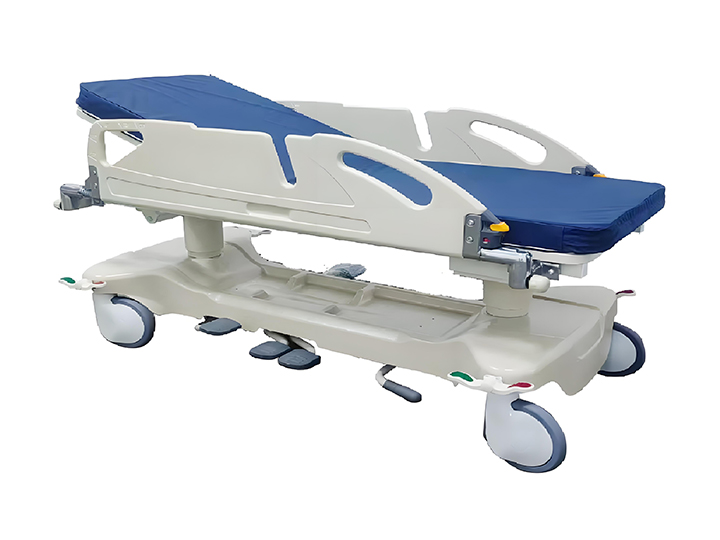
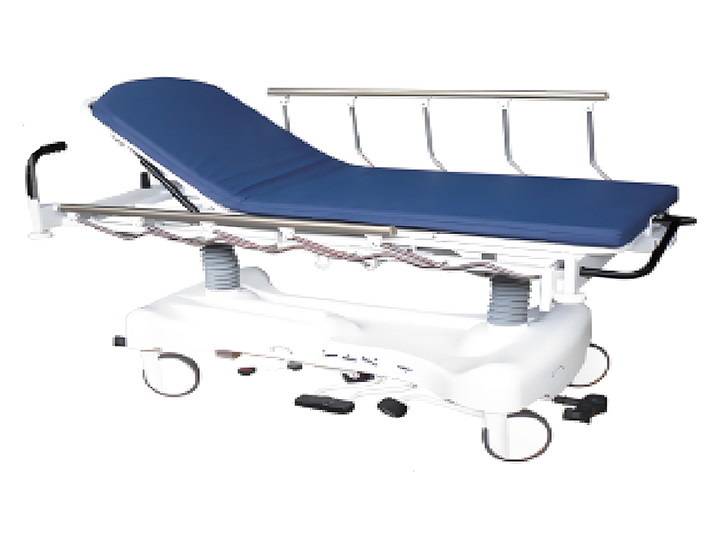
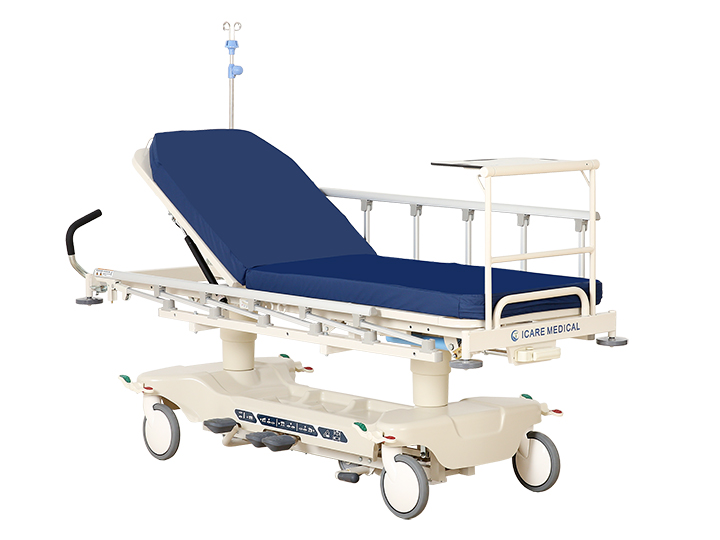
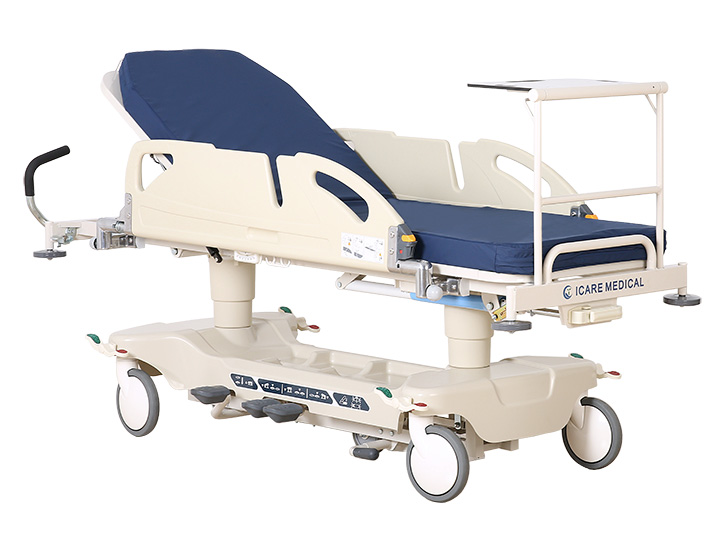
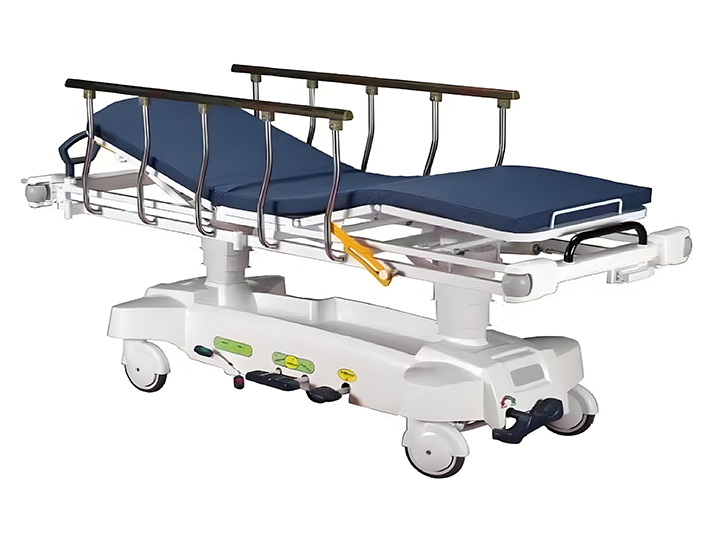
The delivering bed should arrive at the angle the destination posture requires, not at the angle that was convenient in the corridor. ICARE transfer beds run a backrest of 0 to 70 degrees on the CA-808 and the CA-801, with overall tilt of plus or minus 15 degrees on the CA-808 imaging version and plus or minus 15 to 30 degrees across the emergency range. Those ranges are what make it possible to hand a patient over already positioned rather than repositioning them on the table with the surgical field prepared.
| Destination posture | Backrest the bed should arrive at | Verify before the slide |
| Supine, flat | 0 degrees | Bed flattened and locked, brakes set on both units |
| Neuraxial block, sitting or semi-recumbent | 30 to 45 degrees | Head support present, patient's arms controlled |
| Lithotomy | 0 degrees at the slide, legs managed after | Legs still supported by the bed until transfer completes |
| Lateral | 0 degrees | Axillary roll placed on the receiving surface, not on the bed |
| Prone | 0 degrees | Frame and face support in place before the patient moves |
The failure this table prevents is specific. A bed arrives with the backrest at 25 degrees because the patient was more comfortable that way in the holding area. Nobody flattens it. The slide begins, the patient travels 118 newtons worth of downhill, and the receiving team catches the patient rather than guides them. The correction costs four seconds before the slide and cannot be recovered after it.
What ICARE Builds for This Interface
Where modification capability actually helps
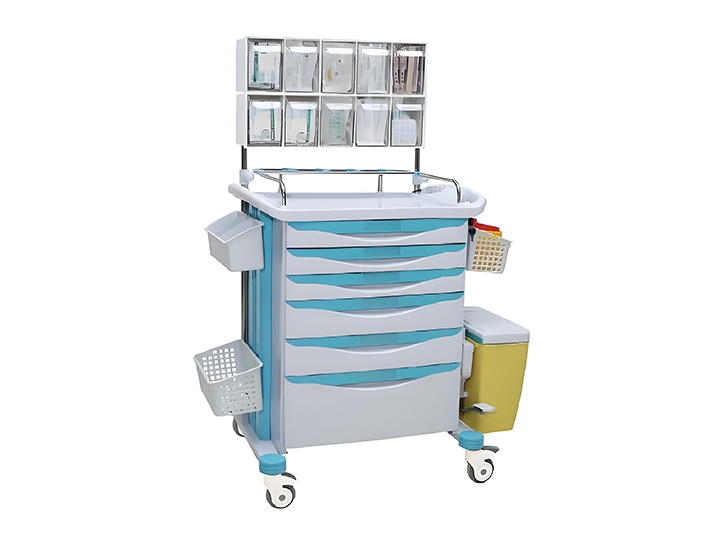
ICARE builds beds, not operating tables. No operating table appears in the range, and the company does not manufacture one. What it does make — transfer beds, emergency beds, medical beds, nursing beds and ward furniture — is the equipment that sets the handover condition described above.
The company designs, manufactures and sells inside one organisation in Binhu District, Wuxi, and that arrangement has one practical consequence for positioning work. A request that a backrest stop at a specific angle, that a rail sit at a particular height, or that a tilt limit be narrowed is not a request routed between a trading office and a distant factory. It lands with the people who draw the bed and the people who weld it. Wuxi Icare Medical Technology Co., Ltd. works from a 5,000 square metre plant with 55 staff, which is small enough for a modification to be a conversation and large enough for it to be built.
Modification capability does not replace measurement. A bed built to a requested angle still arrives at whatever angle the holding area left it in, and the check that matters happens at the table edge, not in the specification.
A positioning handover checklist
Write these onto the transfer documentation and check them at the table edge, not in the corridor.
1. State the destination posture and the backrest angle it requires, and set that angle before leaving the holding area.
2. Flatten the backrest to 0 degrees for any lateral slide, then re-set the angle only after the patient is on the receiving surface.
3. Confirm both units are braked and the bed height matches the table before anyone touches the sheet.
4. Record the shoulder brace pad dimensions and the angle used in any head-down case, so the 690 mmHg figure can be recalculated rather than assumed.
5. Mark the strap position relative to the fibular head at the start of a lithotomy case and check the mark at the end.
6. Mark the sheet at the hip in any lateral case and read the mark at the end, as the only reliable indicator of shear migration.
Six items, one page, and every one of them measures something that a positioning failure would otherwise be discovered three days later in a recovery note.
Recommended News
-
Hospital lift bed selection and usage scenarios
-
Process analysis and practical skills of ward nursing from admission to rehabilitation
-
Functional characteristics and selection of medical diagnosis and treatment examination bed
-
Rehabilitation bed: the key to improving the quality of care for long-term bedridden patients
-
Smart elderly care technology empowers and opens up a new era of elderly care services
-
Function analysis and selection precautions of electric smart bed
-
Guidelines for selecting rehabilitation equipment and analysis of common types
-
Function analysis and selection skills of companion bed
-
New intelligent and community-based development of home-based elderly care
◇◇ Related Content ◇◇
- How Do I Verify The Hospital Bed Factory Before Ordering?
- How Do I Compete With Direct Manufacturer Sales As A Hospital Bed Distributor?
- How Do I Verify The Factory Is Real Before Ordering Hospital Beds?
- What Documents Are Required For Hospital Bed Government Tenders?
- Hospital Bed Government Tender For 200 Beds (Full Guide)
- How Much Does OEM Mold Setup Cost For Hospital Beds?
- Emergency Hospital Bed Order: What "30-Day Delivery" Really Means
- How Long Does OEM Hospital Bed Production Take?
- Hospital Bed Spare Parts Planning: What To Stock For A 50-Bed Fleet