News
News
Docking A Stretcher To A Surgical Table: What The Heights Actually Allow
A surgical table parked at 780 mm and a transfer stretcher that tops out at 850 mm leave 70 mm of margin, and that subtraction is the whole docking question. Everything else in a table specification matters, yet this one figure decides whether a patient crosses from one surface to another with two staff and a slide board or with four staff and a hoist.
This article looks at the surgical table from the transport end. It is written for the buyer who is not purchasing the table but has to make sure the patient reaches it, and it treats the table as a fixed set of constraints: a top height, a rail geometry, a load rating, and an imaging window. ICARE does not build surgical tables. The line covers medical beds, nursing beds, emergency beds, transfer beds and ward furniture, so the table sits on the other side of the interface; what ICARE builds is the end that has to arrive at the correct height, with a footprint that fits the theatre door.
What the surgical table side actually fixes
Height range is a declared value, not a preference
Clinical engineering teams write their table requirements against IEC 60601-2-46, the particular standard for operating tables, and the number they will ask a supplier to declare is the top surface height range under stated test conditions. Ask for that declaration rather than the phrase "adjustable height", because the two are not the same document. A brochure gives you the extremes of travel; the standard declaration tells you what the surface does under load at those extremes.
For the stretcher buyer the consequence is narrow and practical. You need the table's working height during the case, not its maximum, and you need to know whether that working height is a single figure or a band chosen by the surgeon's preference.
Load rating and the moment of transfer
A table rated 250 kg is rated for a patient lying on it. The transfer is a different load case: for a few seconds most of the patient's mass passes over the platform edge rather than resting on the centre, which turns a vertical load into a cantilever.
Run the arithmetic on a 120 kg patient who keeps 60 percent of body mass on the receiving edge during a lateral slide. That is 72 kg, or 706 N, applied near the edge instead of the middle. Nobody needs to know the table's internal structure to see why the question "is your rating static or a working load" belongs in the tender. ICARE transfer beds carry their own declared figures, and the same question applies to them from the other direction.
Top height is the first interface, and the one most often missed
The 70 mm margin problem
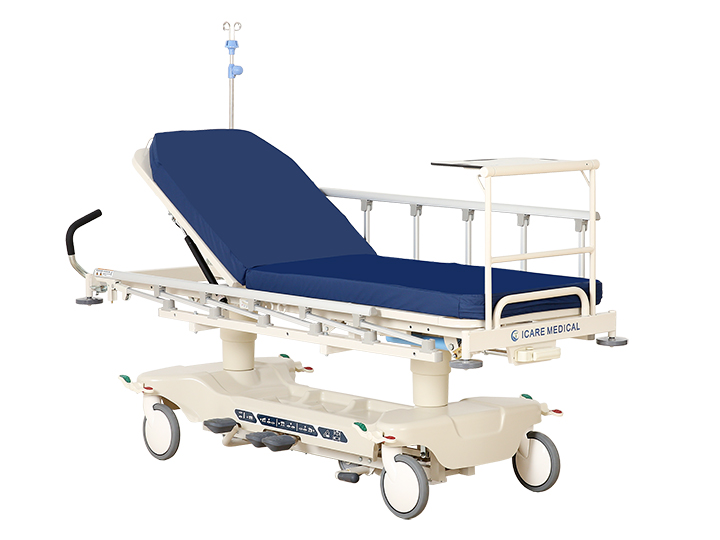
CA-808 lifts by hand crank from 510 mm to 850 mm, a span of 340 mm. Put it beside a table working at 780 mm and 70 mm of that span remains above the table surface, which is 20.6 percent of the travel. The useful band is a fifth of the mechanism.
That proportion is what a buyer should carry away, because it explains a complaint that sounds like a defect and is not one: the stretcher feels as if it has "almost" enough height. It has enough for a table at 780 mm and nothing at all for a table at 850 mm, where the margin reaches zero, or at 950 mm, where it is 100 mm short.
What happens when the table goes to 1000 mm
Raised tables are normal in orthopaedics, in bariatric lists, and wherever the surgeon works standing with the surface above hip height. At 1000 mm the shortfall is 150 mm for a stretcher that stops at 850 mm and 80 mm for one that reaches 920 mm. A 150 mm gap is not a rounding error; it is the difference between a controlled lateral slide and a lift.
The practical fix is not a taller stretcher. It is a rule written into the theatre protocol: the table comes down to the stretcher before the patient moves, and comes back up afterwards. That rule costs nothing and is ignored in a surprising number of rooms, usually because the table's height was set for the previous case and nobody reset it.
Side rails, width and imaging: three more constraints at the table edge
Rail geometry decides accessory collision
The side rail is where a table's accessories live: arm boards, leg supports, screen frames, strap anchors. Each of those occupies the same volume that a stretcher's guardrail wants when the two are brought alongside. Two rail systems can be individually correct and still foul each other, and the collision happens at the exact moment someone is holding a patient.
Ask the table supplier for the rail section and the height of the rail above the platform. Ask the stretcher supplier for the same. Then check the accessory you actually use, not the accessory in the photograph, because an arm board mounted on the head end is usually clear while a leg support at the foot end is not.
Imaging compatibility changes which end you image from
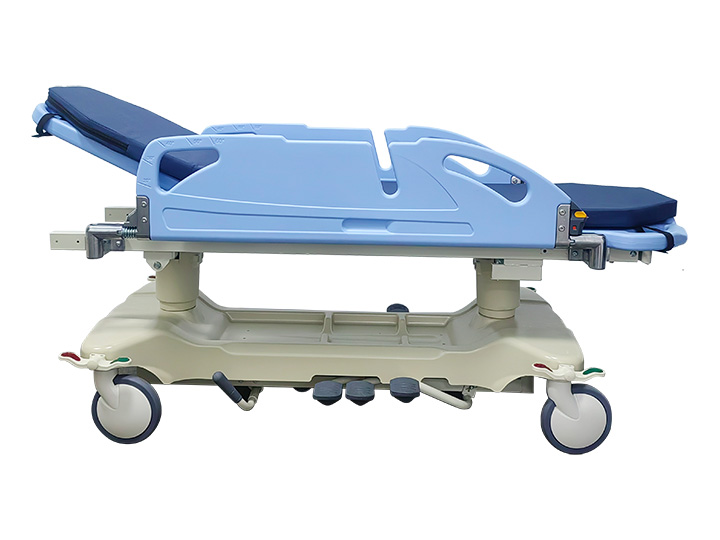
If the case needs intraoperative imaging, the patient stays on the table and the stretcher is irrelevant for that step. If the imaging happens before the case, the stretcher's platform becomes the imaging surface, and a steel deck becomes an obstruction. The imaging version of CA-808 carries an X-ray translucent platform declared compatible with DR and CT, with a hydraulic lift of 540 mm to 880 mm, a 250 kg rating and a 2150 by 750 mm outline.
That difference is worth flagging early because it changes the model, the footprint and the height range in one move. A buyer who discovers it after the order has bought a stretcher that cannot do the first ten minutes of the day.
Matching a surgical table height to ICARE transfer beds
CA-808 at 510–850 mm
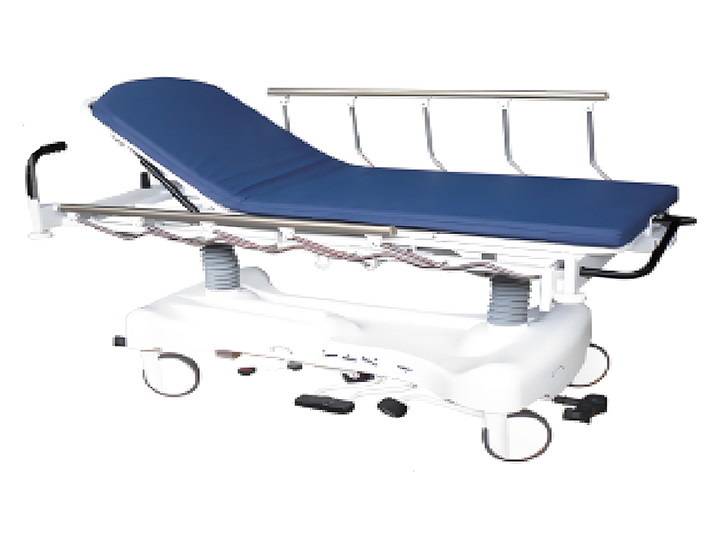
The standard CA-808 is a hand-cranked unit with a 1930 by 663 mm outline, a backrest that opens to 70 degrees on a gas spring, and a 170 kg safe working load with a 250 kg static load. Its 510 mm to 850 mm range therefore covers a table whose surface sits inside that band, which in practice is the low and middle of the theatre range.
CC-805 and CA-807 at the top of the range
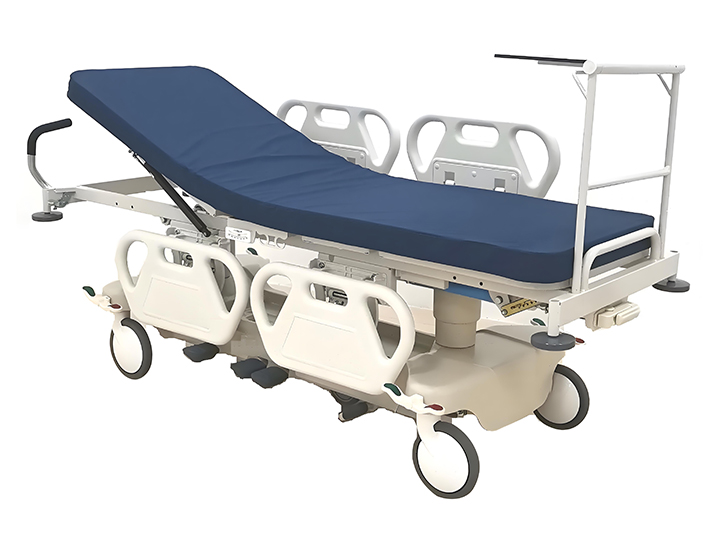
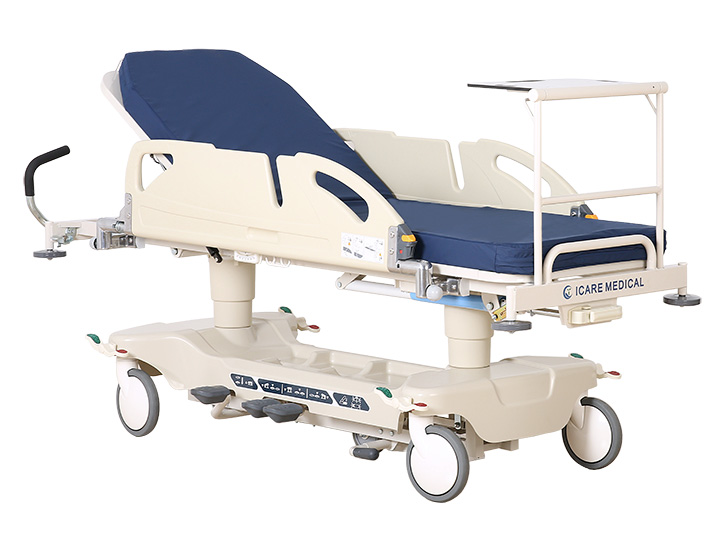
CA-807 uses a hand-cranked hydraulic system with stepless travel from 500 mm to 850 mm, and the manufacturer's own wording is that the range suits hospital beds, operating tables and examination tables. CC-805 is an electric and hydraulic emergency bed with a declared lift from 550 mm to 920 mm and a note on its page that the highest position suits docking with an operating table. Both belong on the shortlist when the theatre runs its tables high.
| Model | Drive | Height range | Span | Margin at a 780 mm table | Overlap with a 700–950 mm table | Rated load |
| CA-808 | Hand crank | 510–850 mm | 340 mm | 70 mm | 150 mm | 170 kg safe, 250 kg static |
| CA-807 | Hand-cranked hydraulic, stepless | 500–850 mm | 350 mm | 70 mm | 150 mm | Not declared on the docking page |
| CC-805 | Electric and hydraulic | 550–920 mm | 370 mm | 140 mm | 220 mm | 300 kg |
| CA-808 imaging version | Hydraulic foot pump | 540–880 mm | 340 mm | 100 mm | 180 mm | 250 kg |
Read the overlap column rather than the span column. A 370 mm span looks more capable than a 340 mm span, but the two spans start from different floor lines, and what the theatre needs is the part of each range that coincides with where its tables actually work.
Two failures at the docking point
The stretcher tops out below the table
Set the stretcher at 850 mm and the table at 1000 mm and you have a 150 mm drop to cross. Bridging that with a slide board over a 500 mm reach gives a slope of 16.7 degrees. Push the gap to 200 mm and the board sits at 21.8 degrees, which is a slide the patient assists or resists, and a two-person job becomes a three-person job with someone standing on the far side.
The failure is not the equipment. It is a theatre that never agreed on a docking height, so each room invents its own.
The rail that will not clear
CA-808 rails can be swung out horizontally to widen the working surface, and that extra width is useful in a recovery bay and awkward in a theatre. Brought alongside a table with a leg support mounted, the deployed rail meets the accessory before the platforms meet, so the stretcher stops short of the table edge and the remaining gap has to be bridged rather than closed. Deploy the rail after docking, not before, and put that sentence into the transfer protocol.
A docking worksheet for procurement
Five measurements before the first case
Write these down from the room, then compare them with the declared figures on the stretcher sheet. A number that is not measured is a number that will be discovered by a nurse at 7 a.m.
Then send the worksheet to the supplier and ask for the model that satisfies every row at once. If the reply is that all models satisfy every row, ask for the outline drawing and the declared height range, and check the drawing against the room. The brand sits inside Wuxi Icare Medical Technology Co., Ltd., a Class I and Class II medical device business that designs, manufactures and sells its own output rather than reselling someone else's frames. That structure is why a drawing request reaches the people who built the stretcher instead of a distributor's catalogue, and why an answer about a specific height range comes back with a number attached to it. | Measurement | Where to take it | What it rules out |
| Table top at working height | Top surface, with the table set for the specialty | Any stretcher whose maximum falls below this figure |
| Table top at lowest height | Same surface, table fully down | Stretchers that cannot reach a low table for paediatric or seated cases |
| Rail height above platform, both ends | Table side, at the accessory you use | Accessory collision with a deployed stretcher rail |
| Theatre door clear opening and threshold | Door frame, measured at the narrowest point | Stretchers whose width or caster size will not pass |
| Floor line of the transfer bay | Under the stretcher casters, not the doorway | Effective lift range, which shrinks when the bay floor is raised |
Recommended News
-
Hospital lift bed selection and usage scenarios
-
Process analysis and practical skills of ward nursing from admission to rehabilitation
-
Functional characteristics and selection of medical diagnosis and treatment examination bed
-
Rehabilitation bed: the key to improving the quality of care for long-term bedridden patients
-
Smart elderly care technology empowers and opens up a new era of elderly care services
-
Function analysis and selection precautions of electric smart bed
-
Guidelines for selecting rehabilitation equipment and analysis of common types
-
Function analysis and selection skills of companion bed
-
New intelligent and community-based development of home-based elderly care
◇◇ Related Content ◇◇
- How Do I Verify The Hospital Bed Factory Before Ordering?
- How Do I Compete With Direct Manufacturer Sales As A Hospital Bed Distributor?
- How Do I Verify The Factory Is Real Before Ordering Hospital Beds?
- What Documents Are Required For Hospital Bed Government Tenders?
- Hospital Bed Government Tender For 200 Beds (Full Guide)
- How Much Does OEM Mold Setup Cost For Hospital Beds?
- Emergency Hospital Bed Order: What "30-Day Delivery" Really Means
- How Long Does OEM Hospital Bed Production Take?
- Hospital Bed Spare Parts Planning: What To Stock For A 50-Bed Fleet
◇◇ Related Products ◇◇