News
News
Nursing Bed Selection Guide: Types, Features, And Patient Care Applications
Nursing beds occupy a distinct space in the medical equipment landscape. While hospital beds serve acute clinical environments, nursing beds bridge the gap between institutional care and home-based patient support. They address the daily needs of elderly patients, post-surgical recovery cases, and individuals with chronic mobility limitations. Selecting the right nursing bed affects caregiver workload, patient skin integrity, and long-term care costs.
Home Nursing Beds vs Institutional Nursing Beds
The distinction between these two environments drives every design decision.
Home nursing beds must fit within a residential room — typically 3-4 meters wide. They need quiet motors that will not disturb other household members, and they must be narrow enough to pass through standard doorways during delivery. Aesthetics matter; families do not want their living room to look like a hospital ward.
Institutional nursing beds — deployed in aged care facilities, rehabilitation centers, and long-term care hospitals — prioritize durability and infection control. These beds face continuous use across multiple patient rotations. Side rails endure repeated impacts. Mattress surfaces face daily chemical disinfection. The frame must withstand 8-10 years of heavy cycling without structural fatigue.
Types of Nursing Beds by Function
Single-Function Nursing Beds
Single-function beds allow adjustment of one section — typically the backrest angle. These serve patients who need the head of bed elevated for breathing comfort, feeding, or reading, but who can reposition their lower body independently. They represent the most affordable electric nursing bed option and remain popular in home care settings where budget constraints are real.
Three-Function Nursing Beds
Three-function models add knee section elevation and overall height adjustment. The knee section articulation is not merely a comfort feature — it prevents the patient from sliding down when the backrest is raised, reducing shear forces on the sacral area. Height adjustment allows the bed surface to align with wheelchair seat height, simplifying lateral transfers.
Five-Function Nursing Beds
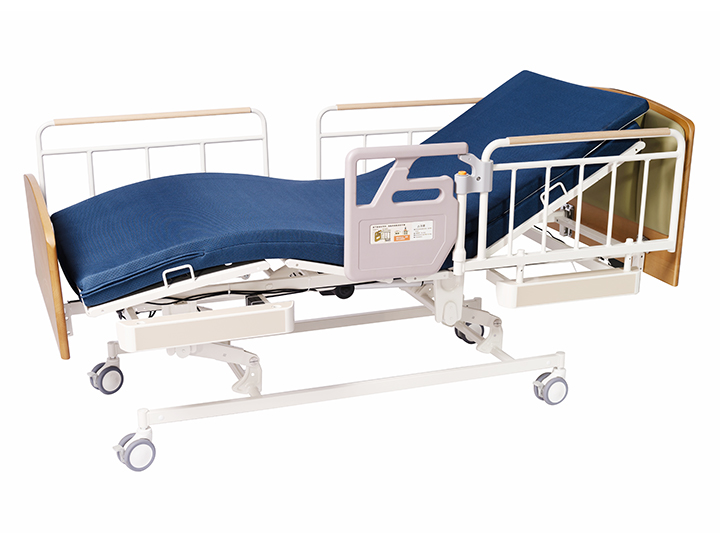
Five-function nursing beds include backrest, knee section, height, Trendelenburg, and reverse Trendelenburg adjustments. In an aged care facility, these beds serve patients with complex positioning needs — including those recovering from hip surgery or managing lower-limb edema. ICARE's CD-805 five-function bed, while marketed for hospital use, is equally appropriate for rehabilitation wards and nursing homes with clinical-grade requirements.
Turning and Repositioning Features
Immobile patients face pressure injury risk within hours of sustained positioning. Nursing staff or caregivers must reposition patients every 2 hours as a baseline standard.
Manual Turning Aids
Some nursing beds include a lateral tilt mechanism — a crank or button that tilts the entire sleep surface 20-30 degrees to one side. This passive turning assists caregivers and reduces the physical strain of manually rolling a 70-80kg patient. It also helps with drainage in patients with chest infections.
Powered Turning Systems
Advanced nursing beds integrate automatic lateral rotation programs. The bed slowly cycles through left, supine, and right positions on a timed schedule. These systems reduce caregiver dependency but add cost and complexity. They are most appropriate for facilities with high ratios of immobile patients.
Anti-Decubitus Design Elements
Pressure ulcers (bedsores) develop when tissue compression exceeds capillary perfusion pressure for sustained periods. Nursing beds incorporate several design features to mitigate this:
• Low-air-loss mattress platforms: These beds connect to an air pump that continuously inflates and deflates alternating air cells within the mattress, redistributing pressure points every 5-10 minutes.
• Lateral rotation therapy: Automated side-to-side tilting reduces sustained pressure on the sacrum and trochanter areas.
• Low-friction mattress surfaces: Nylon or satin-finish mattress covers reduce shear forces when the bed position changes, preventing the skin from dragging against the bedding.
• Integrated weighing: Built-in scales allow nursing staff to track patient weight without transferring the patient to a separate scale, eliminating a painful and risky repositioning event.
ICARE equips its nursing beds with mattress platform designs compatible with leading anti-decubitus mattress systems, and supplies matched mattress options where specified by the purchaser.
Side Rail Safety Systems
Side rails serve a dual purpose: they prevent accidental falls and they provide patients with a gripping surface for self-repositioning. However, poorly designed rails create entrapment hazards. Regulatory bodies worldwide — including the FDA in the US and the European Commission under MDR — have established strict gap dimension requirements for bed rail design.
Key safety requirements:
• Gap dimensions: No opening should allow a 120mm sphere to pass through (this prevents head entrapment)
• Rail height: Minimum 250mm above the uncompressed mattress surface
• Release mechanism: Must be operable by an able adult but not by a confused patient
• CPR access: At least one rail section must drop down quickly for emergency resuscitation access
ICARE nursing beds feature ABS side rails with single-hand release mechanisms compliant with international safety standards. The rail design eliminates the finger-trap gaps that caused numerous injury reports in older bed models.
Target Patient Populations
Elderly Patients
Geriatric patients present a combination of reduced mobility, fragile skin, cognitive decline, and multiple comorbidities. The nursing bed must accommodate:
• Low entry height (minimum 500mm from floor to mattress surface) for fall prevention during transfers
• Firm edge support so patients can sit on the bed edge without rolling
• Clear visual contrast on controls for patients with diminished vision
Post-Surgical Recovery
After orthopedic surgery — hip replacement, knee arthroplasty, spinal fusion — the nursing bed becomes the patient's primary base for 2-6 weeks. The bed must support:
• Precise leg elevation angles for swelling management
• Smooth height adjustment aligned with walking frame height
• Reinforced frame rated for assisted transfers where the patient pushes off the bed rails
Paralysis and Neurological Conditions
Patients with spinal cord injury, advanced multiple sclerosis, or late-stage Parkinson's disease require beds with:
• Full-range articulation for pressure management
• Compatibility with hoist systems for vertical transfers
• Trendelenburg capability for circulatory support
Electric vs Manual Nursing Beds
| Feature | Manual Nursing Bed | Electric Nursing Bed |
| Adjustment mechanism | Hand crank | Push-button motor control |
| Patient independence | None | Patient can self-adjust |
| Caregiver physical demand | High — must crank every adjustment | Low — single-touch operation |
| Power dependency | None | Requires electrical outlet |
| Typical cost range | Lower | Moderate |
| Best suited for | Budget-constrained home care, backup beds | Facilities with daily repositioning needs |
The decision between electric and manual is rarely about absolute cost. When a caregiver adjusts a bed 6-10 times per day — for feeding, hygiene, repositioning, skin checks — the cumulative physical strain of manual cranking becomes a genuine occupational health issue. For institutional settings, electric beds reduce caregiver injury rates and are almost always the rational choice.
Selecting the Right Nursing Bed
Procurement teams should evaluate several factors before finalizing a nursing bed specification. Patient acuity and expected length of stay determine the minimum function count. A patient requiring twice-daily wound dressing changes on the sacral area benefits from a bed that can achieve full lateral rotation, while a patient recovering from a straightforward knee replacement needs stable leg elevation and height control.
Space constraints in the room also matter. A standard ward bed occupies approximately 2.2m × 1.0m of floor space, but the clearance needed for caregiver access on both sides adds another 0.6-0.8m per side. In a small aged care facility room measuring 3m × 3.5m, a compact bed model with reduced overall dimensions may be the only practical option.
Budget allocation should account for the total cost of ownership, not just the initial purchase price. An electric bed with a higher upfront cost but lower maintenance requirements and longer service life often delivers better value over a 10-year deployment than a cheaper manual alternative that requires more frequent replacement.
Home Care Configuration Guide
Families setting up a home nursing station need more than just the bed. A functional home care setup includes:
1. Nursing bed with at minimum 3-function electric adjustment
2. Overbed table for meals and personal items
3. Bedside locker for medications and personal effects
4. IV pole or overhead trapeze for patient self-repositioning assistance
5. Anti-decubitus mattress matched to the bed platform dimensions
6. Bedside commode or urinal to reduce unnecessary transfers
ICARE supplies the complete range of these accessories — including overbed tables, bedside lockers, IV poles, infusion stands, and companion chairs — ensuring dimensional compatibility with every bed model in the product line.
ICARE Nursing Bed Product Line
ICARE (Wuxi Icare Medical Technology Co., Ltd.) manufactures nursing beds and care bed accessories under ISO 13485 quality management standards. The product range includes:
• CD-804 3-Function Electric Nursing Bed: Backrest, knee section, and height adjustment. Suited for home care and general ward use.
• CD-805 5-Function Electric Nursing Bed: Adds Trendelenburg and reverse Trendelenburg for rehabilitation and aged care facilities.
• CC-800/CC-806 Care and Rescue Beds: For clinical settings requiring rapid patient access and advanced positioning.
• Accessories: Bedside lockers, overbed tables, IV poles, infusion stands, and companion chairs designed for seamless integration with ICARE bed frames.
With a 5,000㎡ manufacturing facility and a team of 55+ professionals, ICARE maintains production control and quality consistency across every unit shipped. The company serves healthcare customers across global markets with standardized spare parts availability and responsive after-sales support.
Recommended News
-
Hospital lift bed selection and usage scenarios
-
Process analysis and practical skills of ward nursing from admission to rehabilitation
-
Functional characteristics and selection of medical diagnosis and treatment examination bed
-
Rehabilitation bed: the key to improving the quality of care for long-term bedridden patients
-
Smart elderly care technology empowers and opens up a new era of elderly care services
-
Function analysis and selection precautions of electric smart bed
-
Guidelines for selecting rehabilitation equipment and analysis of common types
-
Function analysis and selection skills of companion bed
-
New intelligent and community-based development of home-based elderly care
◇◇ Related Content ◇◇
- How Do I Verify The Hospital Bed Factory Before Ordering?
- How Do I Compete With Direct Manufacturer Sales As A Hospital Bed Distributor?
- How Do I Verify The Factory Is Real Before Ordering Hospital Beds?
- What Documents Are Required For Hospital Bed Government Tenders?
- Hospital Bed Government Tender For 200 Beds (Full Guide)
- How Much Does OEM Mold Setup Cost For Hospital Beds?
- Emergency Hospital Bed Order: What "30-Day Delivery" Really Means
- How Long Does OEM Hospital Bed Production Take?
- Hospital Bed Spare Parts Planning: What To Stock For A 50-Bed Fleet