News
News
Hospital Bed Types, Features, And Buying Guide For Healthcare Facilities
Hospitals cannot function properly without reliable bed systems. From general wards to intensive care units, the hospital bed serves as the primary interface between patient care and clinical workflow. Choosing the wrong bed type leads to staff fatigue, patient discomfort, and inflated maintenance costs. This guide covers the full spectrum of hospital bed classifications, structural components, mattress options, motor systems, and the key factors procurement teams should evaluate before placing bulk orders.
Classification by Operation Mode
Manual Hospital Beds
Manual beds rely on crank mechanisms for height adjustment and backrest articulation. A side-mounted handle controls a threaded rod that raises or lowers the bed platform. These units remain common in low-acuity settings and developing-market hospitals where electrical infrastructure is unreliable.
Advantages:
• No dependency on power supply
• Lower purchase cost — typically 40-60% cheaper than electric equivalents
• Minimal maintenance; no motor or control board to replace
Limitations:
• Caregivers must physically exert force for every adjustment
• Slower repositioning during emergencies
• Not suitable for ICU or high-dependency wards
Electric Hospital Beds
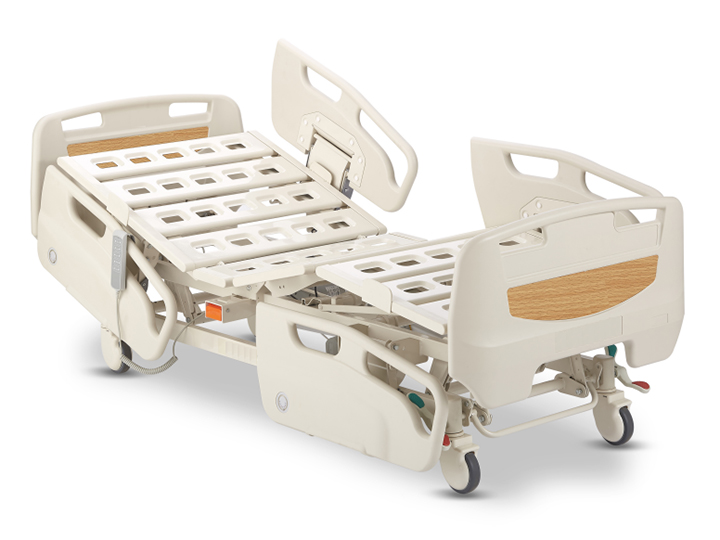
Electric beds use one to four motors to control platform positions. Push-button controls — mounted on the bed rail or accessible via pendant — allow patients and nurses to adjust backrest angle, knee elevation, bed height, and Trendelenburg positioning at the touch of a button.
ICARE's CD-804 and CD-805 electric hospital beds represent this category. The CD-804 offers 3-function adjustment (backrest, knee section, height), while the CD-805 adds Trendelenburg and reverse Trendelenburg capabilities for surgical and critical care applications.
ICU Beds
ICU beds are a specialized subset of electric beds with additional clinical features: integrated weighing scales, CPR quick-release mechanisms, extended height ranges for radiological procedures, and compatibility with infusion pumps and ventilator mounts. They typically operate on 5 or 7 functions, allowing independent adjustment of the back section, seat section, thigh section, leg section, overall height, Trendelenburg angle, and reverse Trendelenburg angle.
Functional Configurations: 3-Function vs 5-Function vs 7-Function
The "function" count refers to independently adjustable positions. Here is a practical breakdown:
| Function Count | Adjustable Positions | Typical Application |
| 3-function | Backrest, knee section, height | General medical/surgical wards |
| 5-function | Backrest, knee section, height, Trendelenburg, reverse Trendelenburg | High-dependency units, step-down wards |
| 7-function | All 5 + independent seat angle + leg section angle | ICU, cardiac care, neuro-critical units |
A 7-function bed gives clinicians granular control over patient posture, which directly affects hemodynamic stability, respiratory function, and pressure redistribution. For a cardiac ward where Trendelenburg positioning is used daily, specifying a 3-function bed creates unnecessary workflow friction.
Bed Frame Construction
The structural material determines durability, weight, radiolucency, and long-term maintenance burden. The choice of frame material affects not only the bed's lifespan but also its compatibility with imaging equipment, ease of cleaning, and overall weight for repositioning within the ward.
Hospital environments are among the most demanding settings for any piece of equipment. Beds are cleaned with aggressive disinfectant chemicals multiple times daily, repositioned across floors by castors, subjected to dynamic loads during patient transfers, and expected to function flawlessly for 8-10 years.
ABS Side Rails
ABS (Acrylonitrile Butadiene Styrene) polymer rails have become the industry standard for general ward beds. They offer good impact resistance, radiolucent properties (allowing lateral X-ray imaging without rail removal), and a smooth surface that withstands hospital-grade disinfectants. ICARE equips all standard ward beds with ABS drop-down rails featuring a single-hand release mechanism.
The radiolucency of ABS is particularly important in busy wards where portable X-ray imaging is performed frequently. Steel rails must be dropped or removed before every lateral radiograph, adding time and increasing the risk of disturbing IV lines and wound dressings.
Stainless Steel Components
Stainless steel (typically SUS 304 grade) appears in structural joints, IV pole sockets, and mattress platform frames. Its corrosion resistance makes it essential for humid environments and tropical climates. Some manufacturers still produce all-steel side rails, though these add significant weight and block X-ray imaging.
Stainless steel also appears in the castor housings and brake mechanisms, where mechanical strength and wear resistance are paramount. The castor assembly is one of the highest-wear components on any hospital bed, as beds are moved dozens of times per day across ward corridors.
Aluminum Alloy Frames
Aluminum alloy construction reduces overall bed weight by 15-25% compared to full steel frames, easing manual repositioning during ward reconfigurations. ICARE uses high-strength aluminum alloy in the CA-800 series transfer bed frame to balance portability with the 200kg+ load capacity required for bariatric patients.
The weight savings from aluminum alloy also reduce the force required to push the bed through corridors, lowering the risk of caregiver musculoskeletal injuries over the product's service life.
Mattress Systems
The mattress is not an afterthought — it directly influences pressure injury rates, patient comfort, and infection control.
• PU Foam Mattresses: Standard density foam, suitable for short-stay patients. Low cost, easy to clean. Minimum thickness should be 100mm for adequate pressure redistribution.
• Memory Foam Mattresses: Viscoelastic foam conforms to body contours, reducing peak interface pressures. Recommended for orthopedic and elderly patients.
• Air Mattress Systems: Alternating-pressure or low-air-loss systems for long-term immobile patients. These reduce pressure ulcer incidence by 40-60% in clinical studies but require a reliable power connection and periodic maintenance.
ICARE supplies matched mattress options for each bed model, ensuring dimensional compatibility with the platform segments.
Motor Systems
The motor is the heart of any electric hospital bed. Two European brands dominate this space:
• Dewert (Germany): Linear actuators known for smooth, quiet operation and 10,000+ cycle durability. Used extensively in premium hospital bed platforms.
• Linak (Denmark): A major global supplier of electric actuators. Linak motors feature integrated control electronics, reducing wiring complexity.
ICARE sources its electric bed motors from established European suppliers to ensure consistent performance across large fleet deployments. When servicing beds in a 500-bed hospital, standardized motor specifications mean maintenance teams carry fewer spare parts.
Essential Accessories
A hospital bed is rarely deployed as a standalone unit. The surrounding accessories determine how effectively the bed system supports patient care and clinical workflow.
IV poles and infusion stands: Most beds include standardized sockets that accept IV poles at multiple positions along the bed frame. A four-hook IV pole is standard; some ICU configurations require six or eight hooks for simultaneous multi-line infusion. The pole must be stable enough to support infusion pumps without wobbling when the bed is in Trendelenburg position.
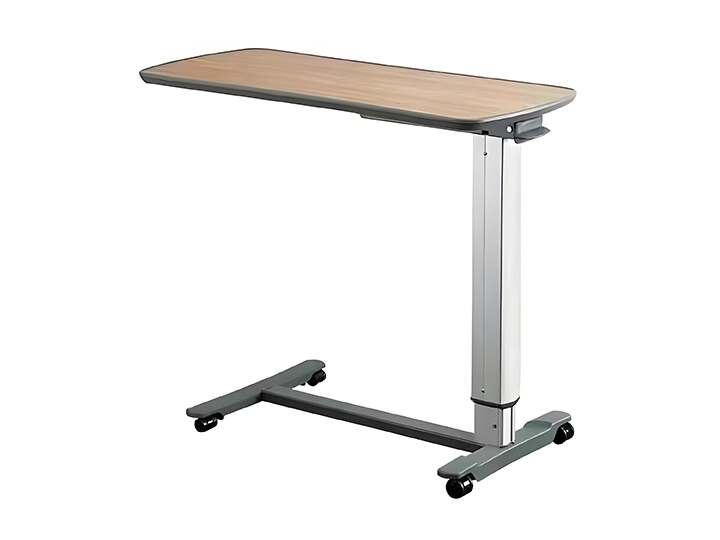
Overbed tables: Adjustable-height tables that swing over the patient for meals, personal items, or laptop use. The table surface height must be independently adjustable from the bed height to accommodate patients in various positions.
Patient lifts and trapeze bars: Overhead trapeze bars allow patients with upper body strength to assist with their own repositioning, reducing caregiver strain and promoting patient autonomy. Ceiling-mounted patient lifts are increasingly common in modern facilities for safe transfer of bariatric and immobile patients.
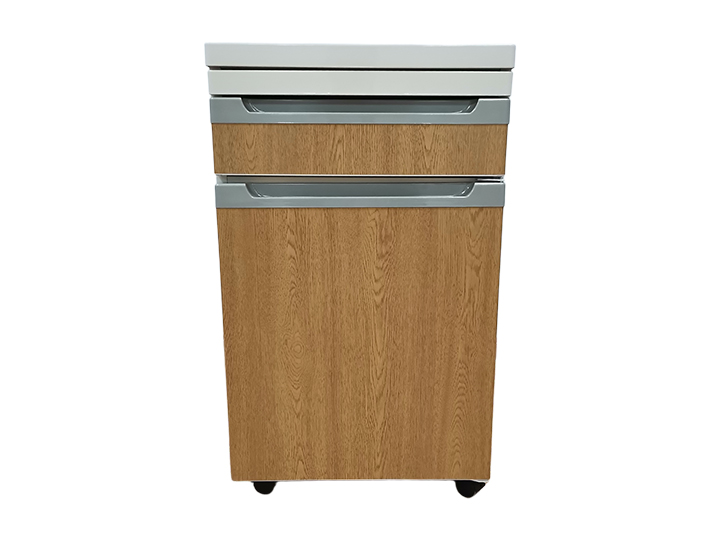
Bedside lockers and companion chairs: Storage for personal effects, medications, and clinical supplies. Companion chairs that convert to occasional beds support family presence during extended hospital stays, particularly in pediatric and palliative care settings.
ICARE manufactures a complete accessory ecosystem designed for seamless integration with every bed model in the product line, ensuring that IV pole sockets, table clamp dimensions, and rail attachment points are standardized across the range.
Maintenance and Lifecycle Considerations
Hospital beds have a typical service life of 8-10 years in institutional settings. During this period, a single bed may undergo 50,000 or more height adjustment cycles, thousands of chemical cleaning sessions, and continuous static and dynamic loading.
Preventive maintenance programs should address motor and actuator testing at 6-month intervals, verifying full range of motion and speed. Castor inspection is equally important — wheels accumulate debris, develop flat spots, and lose bearing lubrication. Brake mechanism testing must be performed monthly, as a failed brake during CPR renders chest compressions ineffective. Electrical safety testing per IEC 60601-1 should be conducted annually, covering ground continuity, insulation resistance, and leakage current.
When evaluating suppliers, ask about spare parts availability and lead times. A bed model with a 12-week motor lead time creates a different risk profile than one with 48-hour spare parts availability. ICARE maintains standardized spare parts inventory across its product line, supporting rapid maintenance turnaround for institutional customers worldwide.
Key Procurement Considerations
Before issuing a purchase specification, procurement managers should address these questions:
1. What patient acuity level will the bed serve? A general medical ward does not need 7-function capability, and an ICU must have it.
2. What is the safe working load? Standard beds support 200-250kg. Bariatric units require reinforced frames rated to 300kg or more.
3. Does the bed accept standard accessories? IV poles, patient lifters, trapeze bars, and overbed tables must be compatible with the rail and socket configuration.
4. What certifications does the manufacturer hold? ISO 13485 certification confirms a documented quality management system for medical devices. ICARE maintains full ISO 13485 compliance across its 5,000㎡ production facility in Wuxi, China.
5. What is the supplier's track record for on-time delivery? A hospital opening with 200 beds cannot wait 16 weeks for a partial shipment. ICARE's in-house manufacturing and 55+ team members enable controlled production scheduling and reliable lead times for international orders.
ICARE Hospital Bed Product Line
ICARE (Wuxi Icare Medical Technology Co., Ltd.) manufactures a comprehensive range of hospital beds designed for global healthcare markets:
• CD-804 Electric Hospital Bed: 3-function, suitable for general medical and surgical wards
• CD-805 Electric Hospital Bed: 5-function with Trendelenburg positioning, ideal for high-dependency areas
• CD-806 Electric Hospital Bed: 5-function enhanced model with extended height range for imaging procedures
• CA-800/801/802 Transfer Beds: Designed for patient movement between departments
• CC-800/806 Emergency/Rescue Beds: Hydraulic and electric lift options for emergency departments
All products undergo rigorous quality testing before shipment, and ICARE provides global after-sales support with standardized spare parts availability.
Recommended News
-
Hospital lift bed selection and usage scenarios
-
Process analysis and practical skills of ward nursing from admission to rehabilitation
-
Functional characteristics and selection of medical diagnosis and treatment examination bed
-
Rehabilitation bed: the key to improving the quality of care for long-term bedridden patients
-
Smart elderly care technology empowers and opens up a new era of elderly care services
-
Function analysis and selection precautions of electric smart bed
-
Guidelines for selecting rehabilitation equipment and analysis of common types
-
Function analysis and selection skills of companion bed
-
New intelligent and community-based development of home-based elderly care
◇◇ Related Content ◇◇
- How Do I Verify The Hospital Bed Factory Before Ordering?
- How Do I Compete With Direct Manufacturer Sales As A Hospital Bed Distributor?
- How Do I Verify The Factory Is Real Before Ordering Hospital Beds?
- What Documents Are Required For Hospital Bed Government Tenders?
- Hospital Bed Government Tender For 200 Beds (Full Guide)
- How Much Does OEM Mold Setup Cost For Hospital Beds?
- Emergency Hospital Bed Order: What "30-Day Delivery" Really Means
- How Long Does OEM Hospital Bed Production Take?
- Hospital Bed Spare Parts Planning: What To Stock For A 50-Bed Fleet