News
News
ICU Electric Bed Specification: A Level-by-level Checklist For The Unit
A 24-bed unit, three patients above 150 kg, and a purchase request whose entire description reads "ICU electric bed, electric, five function". That line is what most units actually send out, and it is why two suppliers can quote the same sentence and deliver beds that behave nothing alike.
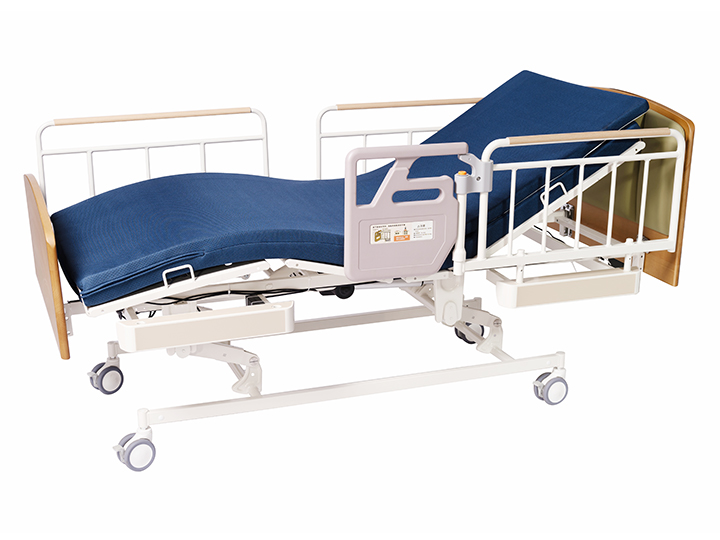
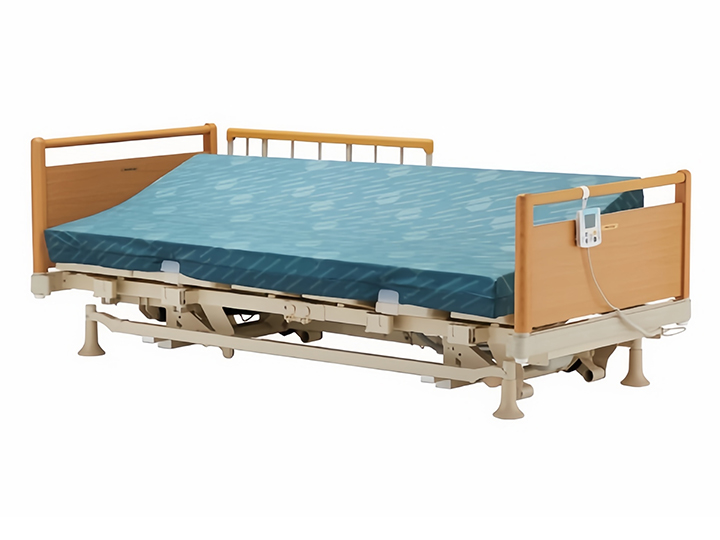
An ICU electric bed is a working platform, not a piece of furniture with motors. Between the frame and the mattress sit decisions about how fast the backrest drops during a resuscitation, how far the head end travels in the head-down position, how much weight the frame carries once accessories are fitted, and whether imaging can shoot through the deck without lifting the patient off it.
This article turns those decisions into a specification you can hand to a supplier. It organises the checklist by ICU level, then puts numbers on the geometry that the brochure language hides.
The ICU electric bed list starts with the unit's level
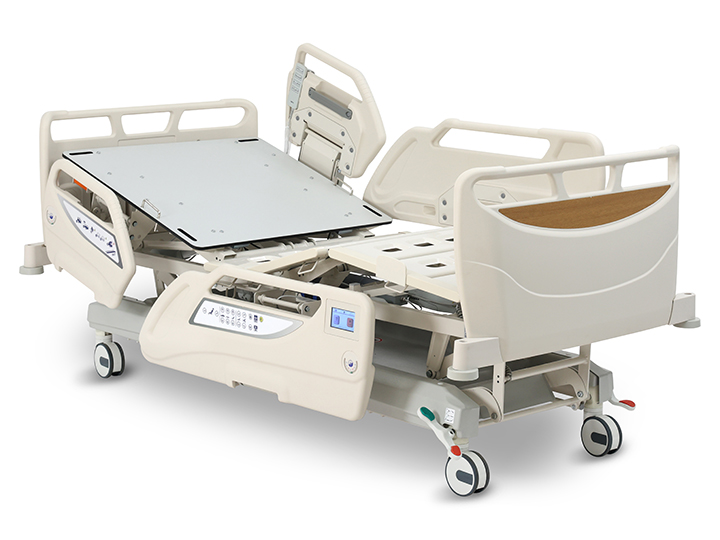
Not every ICU bed position needs the same platform. Tiering the order by where the bed will stand puts budget where it changes outcomes and drops features where it does not.
Level one: general ICU and step-down
These positions need reliable height adjustment, a backrest that reaches a sitting angle, Trendelenburg for routine procedures, CPR release, and a frame rated well above the patients who will actually lie on it. Motor count matters less than the repeatability of the positions the nurses use every shift.
Level two: high dependency and long stay
Long-stay positions add two requirements. The surface has to reduce interface pressure and shorten the time any one body region spends loaded, which is a mattress and turning discipline question rather than a frame question. And the frame has to tolerate daily accessory changes: infusion poles repositioned, drainage hooks swapped side to side, a monitor bracket added at the foot end.
Level three: the resuscitation bay and the imaging-bound patient
The bay that receives the unplanned arrival needs the fastest CPR release on the floor and the widest tilt envelope. The patient who goes to CT or MRI twice a day needs a deck that imaging can pass through. These two requirements rarely sit on the same frame, which is why a single specification for all positions compromises the bay. ICARE splits the two for that reason.
What an ICU electric bed must do in the first sixty seconds
Resuscitation is the one moment when the bed's specification is measured in seconds and degrees rather than in features.
CPR release
The requirement is a single-action release that drops the backrest to flat without hunting for a lever under the mattress. On the CD-804 it is a one-hand CPR handle; on the CC-806 the declared time from release to flat is under three seconds. Write the number into the tender. "Quick release" is not a specification; "backrest to flat in under three seconds, from either side, one action" is.
Check the second half too. After the resuscitation the bed has to return to a working position in one movement, not through a series of manual resets, because the same staff are now cleaning it.
The head-down geometry
Trendelenburg angle is quoted as a number and understood as a feeling. Convert it before you compare frames. A 1950 mm deck tilted to 12° puts the head end 405 mm below its level position, and the head end also shifts about 43 mm horizontally. At 30° the same deck drops 975 mm and shifts 261 mm.
| Deck tilt | Head-end vertical travel | Head-end horizontal shift |
| 12° (CD-804) | 405 mm | 43 mm |
| 30° (CC-806) | 975 mm | 261 mm |
The horizontal figure is the one that catches people out. At 30° a patient's head has moved a quarter of a metre toward the wall side of the bed. Two failures follow from that: a monitor bracket mounted inside the 261 mm arc collides on the first tilt, and a drip stand left at the head end takes the weight of a pump line. Walk the arc with the bed empty before the bay goes live.
Weight, turning and imaging on the ICU electric bed
Three specifications carry most of the clinical load, and each one is easy to state badly.
Capacity margin
A rating is not a target. Take a 140 kg patient, an 18 kg mattress and 12 kg of pumps, poles and hooks: 170 kg on a 250 kg frame leaves 80 kg of margin, or 32 % of the rating. The same arithmetic on a 300 kg frame with a 180 kg patient and 30 kg of accessories leaves 90 kg, or 30 %. Push a 200 kg patient with 38 kg of equipment onto the CC-806 and the margin narrows to 62 kg, about 21 %.
That last figure is the one to watch. Wide patients arrive with more equipment, not less, and the equipment sits on the same frame. Ask for the margin at the load you expect, not the margin at the rating.
Lateral rotation geometry
Turning is specified as an angle per side, and the angle translates into real displacement. On the CC-806, with a 1000 mm deck and ±30° of lateral rotation, the raised edge lifts 250 mm above the level position. A patient whose centre of mass sits 250 mm above the deck surface moves 125 mm sideways as the deck rotates.
Both numbers belong in the training session, not only in the datasheet. The 250 mm edge rise is what stops a roll-out; the 125 mm lateral travel is what pulls on lines, catheters and skin. Fix the lines with slack for 125 mm of travel before the first rotation, and set the rotation interval as a written order rather than a habit. Where a frame offers turning at all, ask which side the patient can be rotated toward and whether both are available, because a patient with a fixed line on one side cannot use a one-directional frame.
Imaging path
Carbon fibre is the material that makes the deck radiolucent, and the thickness is the number that matters. The CC-806 uses a 6 mm carbon fibre X-ray plate, and the frame is declared compatible with DR, CT and MRI up to 3 T. Compatibility up to 3 T is a specific claim; if the imaging department works at a different field strength, verify it in writing rather than assuming the number covers the scanner.
Ask a second question brochures never answer. With the patient on the deck, how much metal sits between the imaging field and the region of interest? A deck that is radiolucent in the centre and braced at the edges still casts a shadow if the field lands on the brace.
Battery, monitor mounting and the mattress interface
These three items decide whether the bed works during a transfer, a power failure or a long procedure.
Battery window
A declared backup of four to eight hours is a range, not a promise, because it depends on how many actuators run and how often. Multiply the movements you expect in a shift and check against the lower end. A bed raised, tilted and adjusted a dozen times an hour draws far more than one that is set once.
Monitor, drain and line management
The ICU hydraulic configuration we publish carries a widened record table at the foot end and a monitor bracket interface, plus heavy-duty infusion poles on both sides and multiple drainage hooks. That combination matters more than it sounds: a monitor at the foot end keeps the head-end arc clear for Trendelenburg, and side-mounted poles keep the deck edge free for a transfer board. Specify the mounting side, and both sides if the unit ever turns the bed around.
Mattress interface
An 80 mm high-density, waterproof, antibacterial foam mattress is the common ward answer. The target is not softness; it is lower interface pressure under the sacrum and heels and shorter dwell time in any one position. Pair the mattress with a turning interval and with a frame that can hold the tilt, and the surface does the work it was bought to do. Any claim that a mattress alone stops pressure injury should be struck from the tender, because the mechanism is pressure, shear and time, and only the time part is the mattress.
Numbers to write into the ICU electric bed tender
The three models below cover the range from general ICU to the resuscitation bay, and they are the frames ICARE builds.
| Model | Positioning | Height range | Tilt | Load | Imaging |
| CD-804 | Five function, four motors, backrest to 75°, leg section to 45° | 450–720 mm | ±12° | 250 kg | Not declared |
| CD-805 | Electric with lateral turning, CPR release | Not declared | Not declared | 300 kg | Not declared |
| CC-806 | Electric plus hydraulic, backrest and leg sections, CPR under 3 s | 520–880 mm | ±30° | 300 kg | 6 mm carbon fibre, DR, CT, MRI to 3 T |
The CD-804 runs 450 mm to 720 mm, a 270 mm travel band, and its 125 mm castors take a three-position central control: locked, free and directional. The CC-806 covers 360 mm of travel, 520 mm to 880 mm, on 200 mm central-lock castors with a directional lock. That 360 mm band is what lets the same frame sit low for a falls-risk patient and high enough to work at standing height during a procedure.
A worked example for a 24-bed unit
Take 18 level-one positions, 4 high-dependency positions and 2 resuscitation bay beds. Those take the five-function frame with CPR release. The high-dependency positions take the turning frame. The two bay beds take the carbon fibre frame with the 30° tilt envelope and the sub-three-second release.
Then run one more number, because it decides the low-height specification. A 70 kg patient falling from a deck at 720 mm releases 494 J of potential energy on the way down. The same patient falling from 450 mm releases 309 J. The difference is 185 J, and the ratio is 1.6. That is the physical case for specifying a low position at or below 450 mm for every bed that a confused or sedated patient can climb out of.
The ICU electric bed range behind the checklist
Three frames, one training standard
ICARE builds the three frames above as one range rather than three unrelated products: the CD-804 five-function bed for general critical care, the CD-805 with lateral turning for the high-dependency patient, and the CC-806 carbon fibre resuscitation bed for the bay and the imaging route. One range means one training session, one accessory list and one service route.
Who manufactures the frames
The three models come from Wuxi Icare Medical Technology Co., Ltd., which designs and manufactures medical beds, nursing beds, emergency beds and transfer beds at one site in Binhu District, Wuxi. A single manufacturing site keeps the specification stable across the range, something a tender clause cannot fix afterwards.
Specify the bed position by position, put the numbers in the tender, and the two quotes will finally be comparable.
Recommended News
-
Hospital lift bed selection and usage scenarios
-
Process analysis and practical skills of ward nursing from admission to rehabilitation
-
Functional characteristics and selection of medical diagnosis and treatment examination bed
-
Rehabilitation bed: the key to improving the quality of care for long-term bedridden patients
-
Smart elderly care technology empowers and opens up a new era of elderly care services
-
Function analysis and selection precautions of electric smart bed
-
Guidelines for selecting rehabilitation equipment and analysis of common types
-
Function analysis and selection skills of companion bed
-
New intelligent and community-based development of home-based elderly care
◇◇ Related Content ◇◇
- How Do I Verify The Hospital Bed Factory Before Ordering?
- How Do I Compete With Direct Manufacturer Sales As A Hospital Bed Distributor?
- How Do I Verify The Factory Is Real Before Ordering Hospital Beds?
- What Documents Are Required For Hospital Bed Government Tenders?
- Hospital Bed Government Tender For 200 Beds (Full Guide)
- How Much Does OEM Mold Setup Cost For Hospital Beds?
- Emergency Hospital Bed Order: What "30-Day Delivery" Really Means
- How Long Does OEM Hospital Bed Production Take?
- Hospital Bed Spare Parts Planning: What To Stock For A 50-Bed Fleet
◇◇ Related Products ◇◇