News
News
Fluid Bed Transfer: Matching The Method To The Patient In Front Of You
A 130 kg patient on an air-fluidized therapy bed has to reach the CT room on the fourth floor, and the charge nurse has two colleagues, one slide sheet and no ceiling hoist. That fluid bed transfer will be settled in the corridor at 22:40, not in a catalogue. Four things decide it: how heavy the patient is, whether she can roll on command, how far her body has to travel sideways, and how many pairs of hands are actually free.
Most ward incidents around this kind of move trace back to a method that did not fit the situation. The equipment was often fine. A 200 kg-rated stretcher is not the answer when the receiving deck sits 50 mm higher than the stretcher deck, and a slide sheet is not the answer when the patient cannot be rolled at all. Method first, hardware second.
This article gives you the method layer. It walks through a decision matrix that runs on weight, cooperation, destination and staffing, then puts real numbers on the force, the gap and the height mismatch that decide whether the move is a two-person slide or a four-person lift. It also states plainly which cell of that matrix ICARE occupies, because we build transfer beds, not therapy beds.
A fluid bed transfer decision gets made in ninety seconds
Picture the corridor scene again. The therapy bed is parked at its working height. The CT trolley arrives with its deck already at chest height. Nobody measures anything, the slide sheet is produced, and four people pull. That sequence works about as often as it fails, and the failure is quiet: a shear load through the patient's shoulders, a nurse's lower back, a line pulled out at the wrist.
The variables that predict the outcome are unglamorous.
Weight and cooperation outrank the diagnosis
Weight sets the floor for staffing. Below roughly 75 kg, two trained people can move a cooperative patient laterally on a low-friction sheet without much drama. Between 75 kg and 130 kg the same move needs either a third pair of hands or an air-assisted mattress that converts sliding friction into a thin air film. Above 130 kg, assume a hoist or a purpose-built lateral transfer device and plan the route before you plan the pull.
Cooperation is the second filter, and it is not the same as consciousness. A patient who can grip a trapeze and bridge on command halves the effort. A patient who cannot be rolled, or who must stay flat because of a fixed neck or a drain, removes the slide sheet from the option list entirely, because a sheet has to be placed under the body before it can be used.
Destination decides whether you move the patient or the bed
If the destination is another room in the same unit, the cheapest correct answer is often to move the whole therapy bed rather than transfer the patient twice. If the destination is a scanner with a fixed table, the patient has to leave the therapy surface, and the question becomes which device carries them there. If the destination is a bed with a different deck height, the transfer device must be able to match that height before anyone touches the patient.
The fluid bed transfer decision matrix
Read the table by row, not by column. Each row is a situation, and the third column is the part that gets skipped in practice.
| Situation | Method that holds up | The constraint people forget |
| Under 75 kg, cooperative, same-room move | Two-person lateral transfer sheet | The receiving deck must be within 30 mm of the therapy deck |
| 75–130 kg, cooperative, same-room move | Air-assisted lateral mattress with three staff | The air supply and its hose need a clear floor path |
| Cannot be rolled, or lines and drains in place | Ceiling hoist with a full-body sling | Sling fit is checked before the hoist is booked, not after |
| Patient must leave the unit | Transfer bed or stretcher matched to the receiving height | Deck width and load rating, both read from the label |
| Long-stay patient, no clinical reason to leave the therapy surface | Move the therapy bed if it is mobile | Door widths and lift dimensions on the route |
Three method families carry most of this work, and each has a hard limit.
Lateral transfer sheets and air-assisted mattresses
These reduce the coefficient of friction between the patient and the surface. A woven slide sheet lands around 0.12 to 0.15 on a dry deck; a cotton draw sheet used as a slide lands nearer 0.35; pulling directly on a sheet that is tucked under the mattress is closer to 0.5. That difference is the whole argument, and it is quantified below. The limit is placement: the sheet has to go under the patient, which requires a roll.
Ceiling hoists
A hoist removes friction from the problem entirely and replaces it with geometry. The patient hangs, so the receiving surface has to be clear of obstructions along the arc, and the sling has to be the right size. Hoists are the right answer for the non-rollable patient and the wrong answer for a corridor with a ceiling that was never load-assessed.
Transfer beds and stretchers
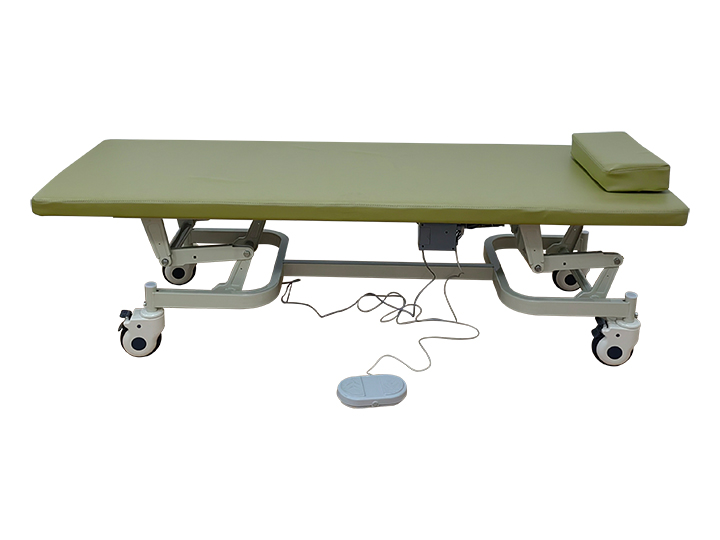
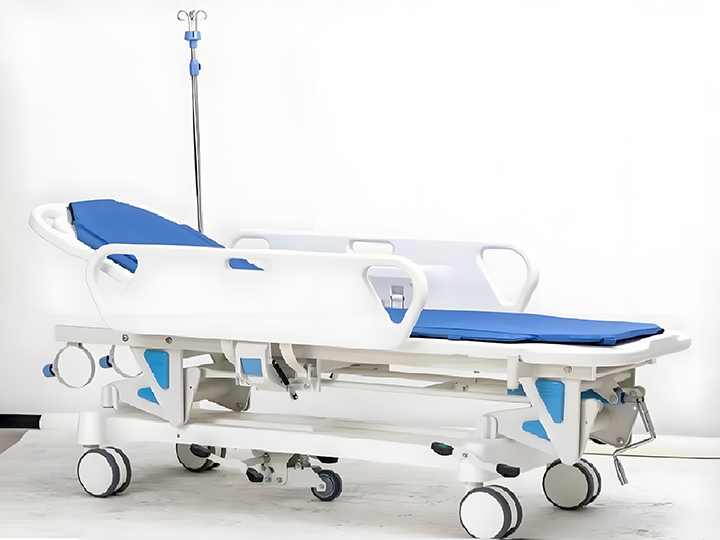
A transfer bed is the only one of the three that also solves transport. It carries the patient from the therapy deck to the scanner and back, and its height range is what lets it meet both ends of the trip. This is the row ICARE builds for.
What ICARE covers, and the one cell we leave alone
The boundary matters for procurement, so here it is without hedging. Of the methods in that matrix, ICARE builds the transfer-bed row and nothing else: the CA transfer range, the CC emergency bed range, the medical and nursing bed lines, and the ward furniture that goes with them. An air-fluidized therapy bed is a different equipment class with a different mechanism, and ICARE does not manufacture one. If your unit already owns therapy beds, the relevant question is only which transfer device meets the therapy deck at the right height and carries the right load.
The people who answer that question sit in one building. Wuxi Icare Medical Technology Co., Ltd. employs a team of 55 across design, production and inspection in Binhu District, Wuxi. Every unit goes through a final inspection against its own drawing before packing, so the load rating that ships with it belongs to that drawing rather than to a series average.
CA-800, CA-801 and CA-808 by the numbers
| Model | Load rating | Height range | Surface | Castors |
| CA-800 | 200 kg | 540–860 mm, hydraulic | 1750 × 580 mm | 150 mm central lock |
| CA-801 | 220 kg | 540–860 mm, hydraulic | 1930 × 640 mm overall | 200 mm central lock |
| CA-808 | 170 kg safe, 250 kg static | 510–850 mm, hand crank | 1930 × 663 mm overall | 150 mm central lock, fifth wheel |
The CA-808 is the endoscopy-oriented frame, with a PP deck, 300 mm side rails that open out horizontally, a drainage tube channel and a twin-tier tray underneath. Its 510 mm bottom height is the number that matters when the therapy deck is set low. The CA-800 is the entry frame and the CA-801 the mid one; both run hydraulic from 540 mm to 860 mm, which covers most ICU and ward deck heights you will meet.
Working the fluid bed transfer numbers
Numbers turn an argument into a specification. All three calculations below use a 95 kg patient, which is a common adult figure for a lateral move, and 9.81 m/s² for gravity.
Push and pull force with two assistants
Horizontal force equals the friction coefficient times the normal load, so the surface under the patient decides almost everything.
| Interface under the patient | Coefficient | Total force | Per assistant, two people |
| Woven slide sheet, dry deck | 0.12 | 112 N | 56 N |
| Cotton draw sheet | 0.35 | 326 N | 163 N |
| Sheet tucked under the mattress | 0.50 | 466 N | 233 N |
Two assistants pulling a draw sheet each take 163 N, which is a sustained one-armed pull at an awkward height, repeated across the gap between two decks. Put the slide sheet in and each assistant is down to 56 N. That is the entire case for the sheet, expressed as a force rather than an opinion. A third assistant drops the draw-sheet figure to 109 N, which is why staffing numbers in a transfer protocol are not decorative.
The 160 mm gap between deck widths
The CA-800 deck is 580 mm wide. An ICU bed surface on the same site runs 830 mm or 900 mm. Set the two decks alongside each other and the centre lines are 160 mm apart, because the difference is split across both edges. The patient's mass has to travel that 160 mm at a minimum, on top of the clearance between the frames.
At a friction coefficient of 0.12, moving 95 kg through 0.16 m takes about 18 J of work. The energy is trivial; the geometry is not. Eighteen joules delivered as a controlled slide is fine. The same displacement attempted across an unsupported 160 mm air gap is a bridge problem, and the bridge has to be a rigid board that spans both frames, not a sheet.
When the deck is fifty millimetres too high
Take a receiving surface at 900 mm and a CA-808 cranked to its top at 850 mm. The stretcher is 50 mm short. A board laid across that 50 mm step sits at 4.3° over a 660 mm span, and no slide sheet will pull a body up a step against a lip, because the sheet follows the low side.
The fix is sequence, not strength. Lower the receiving surface if it moves, or choose a transfer frame whose top height clears it. The CA-800 and CA-801 reach 860 mm, which closes 10 mm of that gap and still leaves 40 mm. Measure both decks before the patient is on either one.
Four ways fluid bed transfer goes wrong
The patterns repeat across units, and three of them cost nothing to prevent.
The therapy deck is left at working height
Therapy decks are usually set for nursing care, which is higher than a stretcher deck. The transfer then happens downhill, and the patient accelerates into the receiving rail. Nothing breaks, so nobody reports it, and the same configuration is used the next night. Write the deck height into the transfer order.
The slide sheet stays under the patient
A slide sheet left in place becomes a low-friction layer under a body that is now expected to stay still. Repositioning later in the shift is easier, and so is sliding out of position. Remove it at the end of the move, and count it during the post-transfer check.
The load rating is read as a patient weight
The CA-808 carries 170 kg safe load and 250 kg static. A 130 kg patient plus an 8 kg mattress plus a 10 kg oxygen cylinder comes to 148 kg, which leaves 22 kg of margin, or about 13 % of the rating. Accessories are part of the load, and so is the assistant who leans on the frame to reach the far rail.
A fluid bed transfer checklist for this week
Run this once on a live move and the gaps become obvious.
What each row is actually testing
The six rows are not a poster for the wall. Each one converts a judgement into a measurement: two deck heights, two deck widths, one rating figure, one friction interface, one staffing count, one look under the patient afterwards. A unit that skips the width row is the unit that discovers the gap with a body over it.
The single highest-value action is the first row. Measure both decks, write the two numbers on the transfer order, and the method choice stops being a judgement call at 22:40. | Check | Threshold | How to verify |
| Both deck heights recorded | Difference within 30 mm | Tape measure, bed at transfer height |
| Deck widths compared | Gap spanned by a rigid board | Measure both, subtract, halve |
| Patient weight against label | At least 20 % margin on safe load | Read the unit rating, add accessories |
| Friction interface chosen | Slide sheet present and dry | Visual, before the roll |
| Staffing matched to weight | Two under 75 kg, three above | Name the three before starting |
| Sheet removed after the move | Zero sheets left under patient | Post-transfer check by second nurse |
Recommended News
-
Hospital lift bed selection and usage scenarios
-
Process analysis and practical skills of ward nursing from admission to rehabilitation
-
Functional characteristics and selection of medical diagnosis and treatment examination bed
-
Rehabilitation bed: the key to improving the quality of care for long-term bedridden patients
-
Smart elderly care technology empowers and opens up a new era of elderly care services
-
Function analysis and selection precautions of electric smart bed
-
Guidelines for selecting rehabilitation equipment and analysis of common types
-
Function analysis and selection skills of companion bed
-
New intelligent and community-based development of home-based elderly care
◇◇ Related Content ◇◇
- How Do I Verify The Hospital Bed Factory Before Ordering?
- How Do I Compete With Direct Manufacturer Sales As A Hospital Bed Distributor?
- How Do I Verify The Factory Is Real Before Ordering Hospital Beds?
- What Documents Are Required For Hospital Bed Government Tenders?
- Hospital Bed Government Tender For 200 Beds (Full Guide)
- How Much Does OEM Mold Setup Cost For Hospital Beds?
- Emergency Hospital Bed Order: What "30-Day Delivery" Really Means
- How Long Does OEM Hospital Bed Production Take?
- Hospital Bed Spare Parts Planning: What To Stock For A 50-Bed Fleet