News
News
A Medical Records Cart Has To Survive The Round, Not The Showroom
A 44-bed ward split between two teams produces 46 stops on a morning round, and at every one of them a medical records cart is braked, opened, closed, secured and pushed on. Nine seconds per stop is 207 seconds per team, three and a half minutes of a round spent doing nothing but parking a box. Nobody specifies a cart against that number. They specify it against a photograph.
The photograph is the problem. A cart photographed in a showroom is empty, lit from the front, and standing still. The same cart on a Tuesday morning carries 42 folders, a shared consent file, a transfusion chart, a drug register and a stack of forms that arrived from administration overnight, and it is parked at a bed while two people lean over it and a third waits behind it.
Capacity is the easy part to state and the hard part to get right, because three capacities collide on one frame: folders, medication, and loose paper. This article works those three numbers against a real ward, then follows the cart through the parts of the round where it fails: the lock, the sliding shelf, the wheels, and the corridor.
What a Medical Records Cart Carries on a 44-Bed Ward
The folder count is the first capacity decision
A 44-bed ward at 95 percent occupancy holds 41.8 patients, so 42 folders are live on any given morning. Add the documents that do not belong to one patient — the consent set, the transfusion record, the controlled drug register, the imaging log, the discharge pack, the blank form stock, the ward diary, the untranscribed order set — and the real demand is 50.
The F-024 record cart holds about 50 A4 folders in double vertical slot rows that sit between its two lockable cabinet doors. Fifty slots against 50 documents leaves zero headroom, and zero headroom is a design defect rather than a tight fit, because every admission adds a folder before the discharged patient's folder is collected.
| Document class | Demand at 95 percent occupancy | F-024 capacity | Headroom |
| Patient A4 folders | 42 | About 50 in the two slot rows | 8 |
| Shared ward documents | 8 | Shares the same slot rows | 0 |
| Medication stock lines | 62 active lines | 48 compartments plus one large drawer | 14 lines over |
| Loose forms and stationery | Continuous | Top sliding shelf and two upper drawers | Adequate |
Medication capacity is a separate number
The 48 compartments sit alongside a large drawer, and 48 against 62 active stock lines is 77 percent coverage. Fourteen lines then live in the large drawer, which is where the looking starts: a drawer with fourteen unlabelled boxes in it costs more seconds per stop than a compartment that is one of forty-eight. Either the stock list is trimmed to the compartment count, or a second cart carries the overflow, or the drawer is compartmented with a printed map. Deciding which of those three is the decision, and it is usually made by accident.
Zoning: The Top Shelf Decides the Round
Four zones and what must never cross them
The F-024 cart ICARE builds has four usable zones, and each one has a job. Mixing them is what makes a round slow, because a hand that has to search is a hand that is not writing. The blue-bordered sliding top shelf takes what is in the hand at the bedside: the folder being written in, a pen, a small dressing pack. The two upper drawers take what is used by the dozen: stamps, pens, forms, small items. The slot rows take folders in patient order. The locked cabinet behind the doors takes what must not walk.
| Zone | Belongs here | Must never appear here | What goes wrong when it does |
| Sliding top shelf | Active folder, pen, small pack | Loose drug boxes, sharps | Shelf jams on a protruding corner |
| Two upper drawers | Stamps, pens, blank forms | Patient folders | Folder gets folded into a drawer |
| Two vertical slot rows | A4 folders in bed order | Oversized imaging envelopes | Rows bow and folders drop through |
| Locked cabinet and central lock | Controlled stock, registers | Anything needed mid-round | Round stops while a key is found |
The raised lip around the sliding shelf is the part that matters more than the sliding. A shelf that slides without a lip loses a pen per round and a folder per week, and a folder on the floor of a ward is a confidentiality incident with a form attached.
Why the sliding shelf jams
A sliding shelf fails in one specific way: something taller than the clearance gets put on it, and the next push shears the runner. The top shelf is where the folder in use lands, and folders are not flat — a folder with an imaging envelope inside is 15 mm thicker at one end. Either the shelf clearance is specified against the thickest folder the ward uses, or imaging stays in a separate envelope holder and never on the shelf.
Locks, Disinfectant, and the Parts That Fail First
The shell is ABS; the lock is not
The F-024 shell ICARE builds is all ABS engineering plastic, specified as resistant to medical disinfectants, waterproof, impact resistant and wipe-clean. That sentence describes the shell. It says nothing about the lock barrel, the hinge pin, the drawer runner or the caster axle, and those four parts are where a cart dies.
Nine wipe-downs a day across three shifts is 2,250 wipe passes over the same panels in a 250-day year. The ABS panels tolerate that. A zinc-plated lock barrel wiped 2,250 times with a chlorine-releasing solution does not, and the failure is not dramatic: the key turns halfway, then needs a second hand, then the cart stays unsecured for a whole shift because someone is too busy to fight it. A record cart left unsecured on a round is the exact condition the lock was bought to prevent.
Ask two questions before ordering. What is the barrel made of, and what does the manufacturer say about chlorine-releasing wipes on it. If the answer is silence, the cart has a five-year shell and a two-year lock.
Casters and the floor
Four PU silent casters are the right default for a ward: quiet on vinyl, no marking, and enough compliance to roll over a threshold strip. What kills them is hair and thread wound around the axle, which turns a rolling wheel into a skidding one. A skidding wheel does not announce itself; it shows up as a cart that drifts 100 mm after it is parked, which puts the open folder out of the writer's reach and puts the cart into the walking line.
The second caster failure is a brake that holds the wheel and not the swivel, and it is worth confirming which type is fitted before ordering. A cart with two braked casters out of four pivots at the bedside when someone leans on it, and the lean is what happens when a nurse writes while standing.
Paper and the Electronic Record Running Side by Side
What stays on the cart during the parallel period
Almost no ward moves from paper to screen in one step. It runs both for a year or more, and during that year the cart carries a hybrid load that neither the paper-era cart nor the screen-era cart was designed for. The practical split that survives contact with a round is by document type rather than by convenience.
| Document type | Where it lives during the parallel period | Why |
| Order sets signed at the bedside | Folder, in the slot row | Signature is captured on paper |
| Observation charts | Folder, or a chart clip on the cart | Written during the round |
| Medication administration record | Folder until the e-system is live on that ward | Two systems cannot both be authoritative |
| Imaging reports | Separate envelope holder, not the top shelf | Thickness breaks the shelf clearance |
| Discharge summaries | Locked cabinet | Printed late, collected late |
The failure that recurs is the duplicate. A ward that keeps a paper folder "just in case" while the same record is live on screen ends up with two versions of the same order set and one of them is wrong. A cart cannot fix that. What a cart can do is make the paper half orderly enough that the duplicate is visible, which means one slot per patient, in bed order, with nothing else in the row.
Specifying a Medical Records Cart Against the Route You Walk
Measure the route, not the ward
A 22-bed team walking 11 m between beds covers 242 m per round, and the cart covers it too. The number that decides whether the cart is usable is not the distance. It is the number of times the cart has to leave the walking line to be parked, and the number of places where it cannot be parked without blocking something.
Walk the route once with a stopwatch and a tape. Note every doorway the cart passes through, every corner it turns, and every bedside where the only flat space is the foot of the bed. A cart that has to be parked in the corridor is a cart that is left in the corridor, and a corridor with a cart in it is a corridor that fails a fire inspection.
The accessory line around it
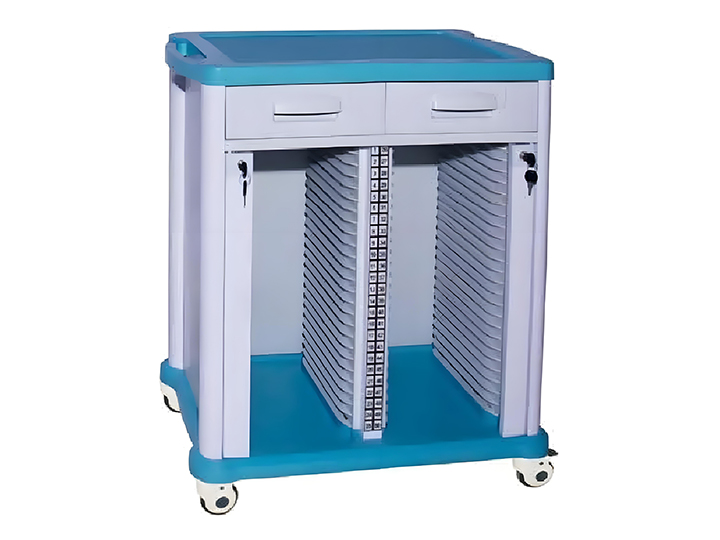
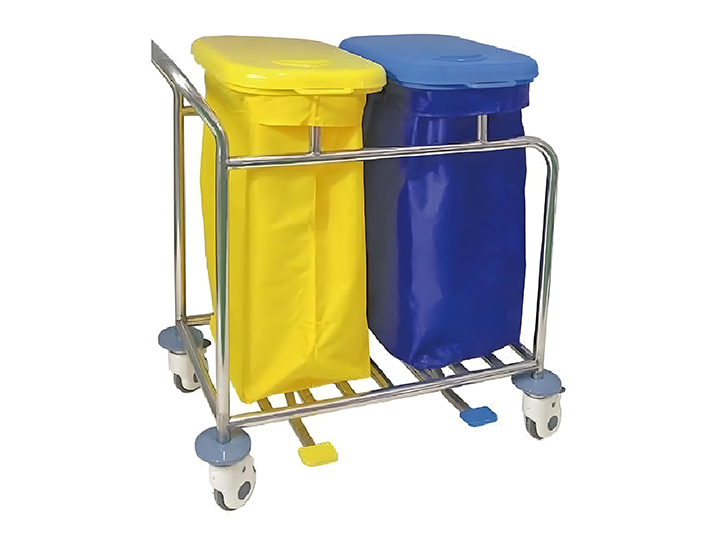
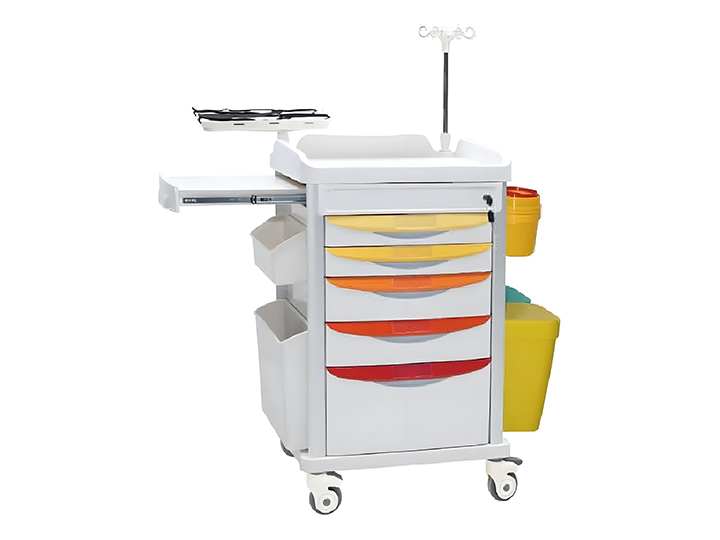
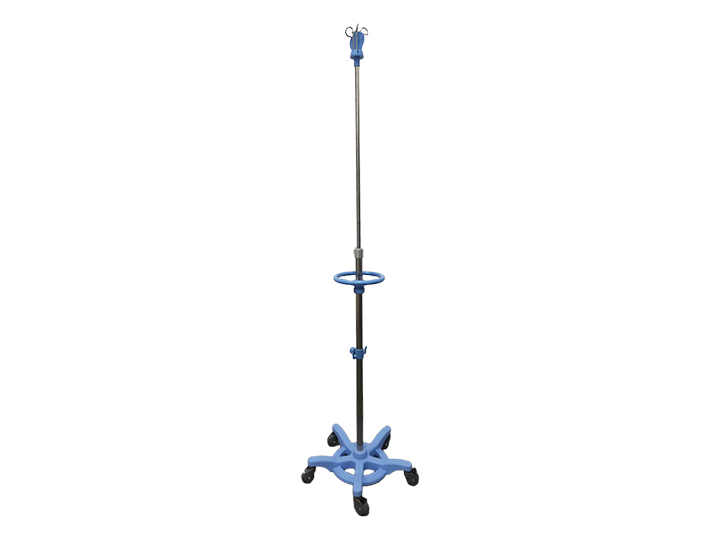
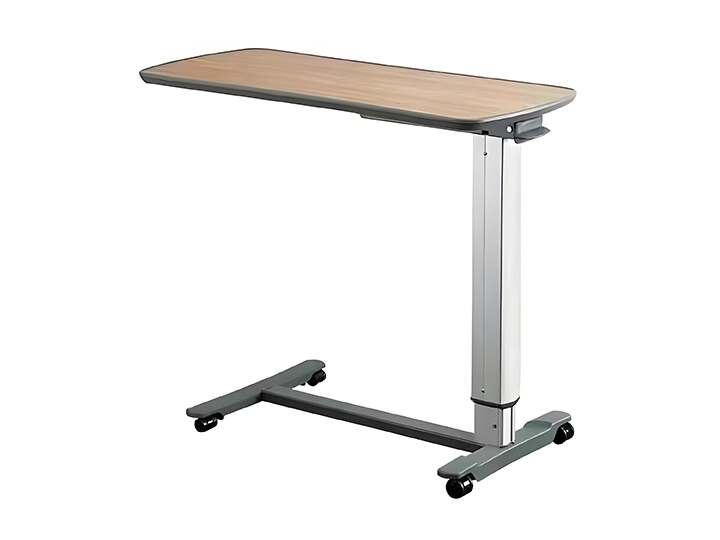
A record cart does not run alone on a round. It runs in a sequence with the medication trolley and the dressing trolley, and it is parked next to furniture that has to survive the same cleaning regime. ICARE builds the ward furniture line from F-001 to F-025, and the record cart sits inside that range rather than apart from it: the F-001 bedside cabinet, the F-002 overbed table on its U-shaped base, the F-003 infusion stand, the F-007 emergency trolley, the F-008 utility trolley, the F-011 medication storage cart, the F-015 folding accompanying chair, the F-023 morning care cart and the F-025 waste segregation trolley. A ward that specifies these together can keep one cleaning agent, one spare-parts list and one caster type across the whole floor.
The F-024 cart comes out of the same plant as the rest of that range - Wuxi Icare Medical Technology Co., Ltd., Binhu District, Wuxi - rather than from a separate supplier. Buying the cart from the same line as the medication trolley and the waste trolley is not a branding argument. It is the difference between one set of wheels in the store room and four.
Six checks before the cart goes on the ward
Run these in the order given, on the actual ward, with the actual round list in hand.
1. Count live folders at peak occupancy and add the shared documents. If the total equals the slot count, order the next size up or split the round.
2. Count active medication lines and compare with 48 compartments. Write down what the overflow strategy is, in words, on the order.
3. Measure the thickest folder the ward uses and check it against the sliding shelf clearance.
4. Ask what the lock barrel is made of and which disinfectant the ward actually uses, then check the two against each other.
5. Walk the route and count parking points that require leaving the walking line. More than four per round means the cart needs a smaller footprint or the round needs two carts.
6. Confirm that every caster brakes the swivel, not only the wheel, and test it by leaning on the corner of the loaded cart.
A cart that passes all six is a cart that will still be in service when the ward finally retires paper, and its slot rows will still be the right shape for whatever the screen cannot yet hold. ICARE builds the F-024 into the same range as the trolleys it will stand beside, so those six checks run against one supplier instead of four.
Recommended News
-
Hospital lift bed selection and usage scenarios
-
Process analysis and practical skills of ward nursing from admission to rehabilitation
-
Functional characteristics and selection of medical diagnosis and treatment examination bed
-
Rehabilitation bed: the key to improving the quality of care for long-term bedridden patients
-
Smart elderly care technology empowers and opens up a new era of elderly care services
-
Function analysis and selection precautions of electric smart bed
-
Guidelines for selecting rehabilitation equipment and analysis of common types
-
Function analysis and selection skills of companion bed
-
New intelligent and community-based development of home-based elderly care
◇◇ Related Content ◇◇
- How Do I Verify The Hospital Bed Factory Before Ordering?
- How Do I Compete With Direct Manufacturer Sales As A Hospital Bed Distributor?
- How Do I Verify The Factory Is Real Before Ordering Hospital Beds?
- What Documents Are Required For Hospital Bed Government Tenders?
- Hospital Bed Government Tender For 200 Beds (Full Guide)
- How Much Does OEM Mold Setup Cost For Hospital Beds?
- Emergency Hospital Bed Order: What "30-Day Delivery" Really Means
- How Long Does OEM Hospital Bed Production Take?
- Hospital Bed Spare Parts Planning: What To Stock For A 50-Bed Fleet