News
News
How Many Surgical Tables A Multi-Specialty Suite Really Needs
A twelve-hour block running eight cases at 58 minutes of operating time and 21 minutes of changeover consumes 632 of the 720 available minutes, and every minute of that arithmetic is paced by the surgical tables in the room. Lights can be borrowed from the next theatre. A monitor can be wheeled in. The surface a patient lies on cannot be shared, and it cannot be released until the previous patient has physically left it.
Suites rarely buy on that logic. They buy on specialty requests. Orthopaedics wants its own, urology wants its own, the cardiac list wants its own, and each request is defensible when you read it alone. The suite then owns three tables, two rooms, and a Tuesday list that still finishes ninety minutes late.
The binding constraint is usually not the number of tables. It is the interval between one patient leaving a surface and the next patient arriving on it, and that interval belongs to people and equipment outside the room: the transfer bed, the recovery bay, the specialty cart, the housekeeping sequence. Counting tables without timing that interval produces a capital number that answers nothing.
This article treats the count as a scheduling decision. It works the arithmetic for one table against several, names the setups that should never be dismantled, and follows the queue out of the room to the docking end. ICARE builds transfer beds rather than surgical tables, so the segment of this chain that can be described with measured values here is the segment that arrives at the table edge.
The Table Count Is a Scheduling Number, Not a Purchase Number
Read the block list before the catalogue
A block list is a list of minutes that happens to be written as a list of cases. Pull four consecutive weeks of the same list and count three quantities per day: operating minutes, changeover minutes, and the number of changeovers that ran past 30 minutes. If the third number is above one per week, the constraint is not capacity. It is the rebuild step, and buying a fourth table will not touch it.
Two numbers from the same four weeks expose the same thing from a different side. Compare the room's first-case on-time rate with its last-case finish time. A room that starts on time and finishes late has a turnover problem. A room that starts late and finishes late has a pre-operative problem. Neither is solved by a larger table fleet.
Split table-bound time from room-bound time
Table-bound time is anything that requires the patient to be on or off the surface: positioning, the procedure itself, the transfer on and the transfer off. Room-bound time is everything else: counts, cleaning, re-draping, bringing in the next instrument set, waiting for the recovery bed. In a typical eight-case day the split runs close to 464 minutes table-bound against 168 minutes room-bound.
Only the table-bound half responds to adding a table. The room-bound half responds to parallel work, which means a second room rather than a second table inside the same room. That distinction alone kills most of the proposals that arrive as "we need one more table".
One Set of Surgical Tables or Three: Run the Arithmetic
Take a 720-minute block, 58 minutes of operating time per case, and 21 minutes of changeover. The number of cases that fit is 720 divided by 79, which is 9.11, so nine cases fit with nine minutes to spare and ten cases overrun the block by 70 minutes.
The turnover ceiling that decides the case count
Ten cases in that block requires changeover at or below 14 minutes, because 720 minus 580 minutes of operating leaves 140 minutes to divide across ten turns. Twenty-one minutes per turn is not a small inefficiency at that volume; it is the entire difference between nine and ten cases. Anyone proposing a table purchase to reach ten cases should be asked what the 14-minute turn looks like, because that turn is the actual product being bought.
| Configuration | Cases per 12-hour block | Changeover minutes inside the block | Slack remaining | First thing to break |
| One room, one table | 9 | 189 | 9 minutes | Any changeover above 22 minutes |
| Two rooms, two tables | 18 | 378 | 18 minutes | Recovery capacity and staffing, not tables |
| Two rooms, three tables | 18 | 378 | 18 minutes | Nothing at this volume; the third table idles |
| One room, two tables | 9 | 189 | 9 minutes | Room-bound work, which the spare table cannot absorb |
The third row is the one worth arguing about. A third table in a two-room suite does not add a case. What it adds is the ability to pre-set a specialty configuration while the other table is in use, which recovers the specialty-change penalty described below and nothing more.
What a specialty change actually costs
A changeover inside one specialty is mostly cleaning and re-draping. A changeover across specialties adds a rebuild: the mounted set comes off, a different set goes on, and the room has to be re-checked. On a list that moves from general surgery to urology to orthopaedics, three cross-specialty turns at 40 minutes instead of 21 minutes cost 57 minutes, which is 0.98 of a case at 58 minutes. The third table buys back roughly one case per day and requires somewhere to park it.
Specialty Setups Worth Leaving Mounted
Three configurations that should not be rebuilt daily
A setup that is used on at least three cases per week should not be stripped at the end of the day. The labour of rebuilding it is paid in the most expensive minutes of the schedule, between cases, with the room occupied and the next patient in holding. Keeping a mounted set on a dedicated table converts those minutes into zero.
The reverse also holds. A setup used once a fortnight should not occupy a table, because the table then exists to store accessories. That is how suites end up with three tables and nine usable cases: two of the surfaces are warehouses.
| Specialty block | Mounted set that should stay on the table | Strip-and-rebuild minutes | Kept-mounted minutes | Binding constraint when stripped |
| Open abdominal, repeated | Arm boards, footboard, basic straps | 38 | 19 | Rebuild collides with housekeeping |
| Laparoscopic, repeated | Arm boards, lead apron rail, camera holder bracket | 35 | 18 | Rail brackets re-checked twice |
| Urology, repeated | Leg supports, drainage routing, irrigation line clips | 42 | 21 | Supports hunted from a shared cart |
| Orthopaedic limb, repeated | Traction bracket, sandbags, limb support | 45 | 22 | Traction bracket re-zeroed |
| Head and neck, occasional | Head rest, chair adapter | 33 | 17 | Not worth a dedicated table |
Those minute values are planning figures. Replace them with your own timing study before they enter a capital request; the ranking of the column is what matters, and the rebuild penalty clusters in the same four places every time.
The parts nobody re-stocks between cases
Every stripped setup loses small parts. Irrigation clips, strap buckles, rail clamps and drainage hooks migrate to other rooms and are rediscovered three cases later. The practical answer is a sealed accessory box per specialty, labelled, checked at the start of the block rather than between cases. A box that is checked between cases is checked in the most expensive minutes of the day.
The Queue at the Table Edge: Where Surgical Tables Meet Transfer Beds
Who is waiting, and on what
Four resources queue at a table edge, and the table is only one of them. The patient waits in holding, the transfer bed waits in the corridor, the table waits for the room, and the recovery bay waits for the patient. When any one of them slips, the table sits empty and the block burns minutes that no purchase order recovers.
| Queue position | What must be true at the moment of handover | Typical wait when it is not | Who absorbs the loss |
| Patient in holding | Consent and site mark complete, IV running | 12 to 25 minutes | Whole block, shifted |
| Transfer bed | Freed from its previous job, height set to the table | 10 to 20 minutes | Table sits empty |
| Table | Room cleaned, mounted set restored | 6 to 18 minutes | Next case starts late |
| Recovery bay | Bed available, handover nurse present | 8 to 30 minutes | Table blocked after the case, not before |
The fourth row is the one most often missed. A table that cannot be released after a case is exactly as unavailable as a table in use, and the cause sits two departments away.
Two failures that happen at the docking moment
The first is the borrowed recovery bay. A bed that is holding a recovering patient at 10:20 cannot collect the 10:30 case, so the table is free, the room is clean, and nothing moves for twenty minutes. The suite reads this as a table shortage. It is a bed-allocation problem, and the fix is a dedicated collection bed per two rooms, not a fourth table.
The second is approach geometry. Accessories mounted on the side rail the transfer bed needs to approach from turn a straight lateral slide into an angled one. Two staff become three, the slide takes four minutes longer, and the sheet is dragged under the patient instead of being rolled. Deciding which side of the table stays clear is a rail-and-accessory decision made months before the case, and it is free.
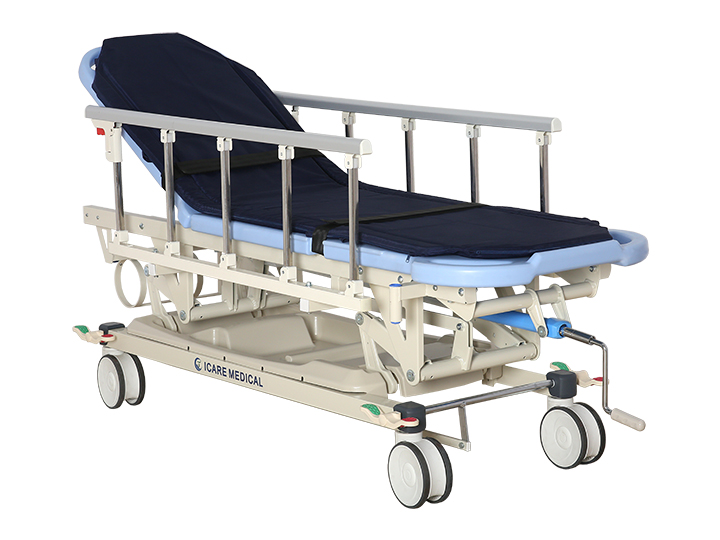
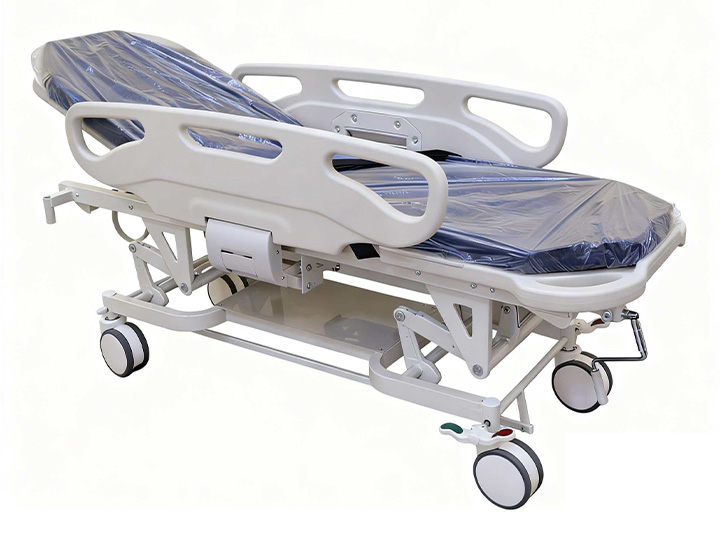
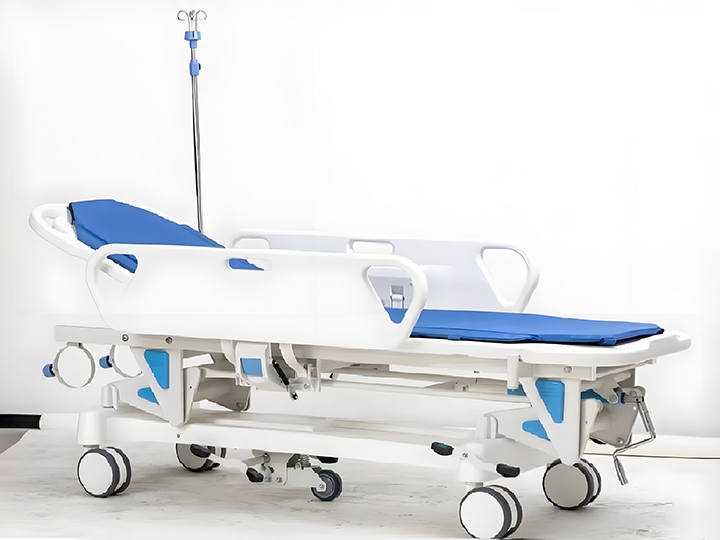
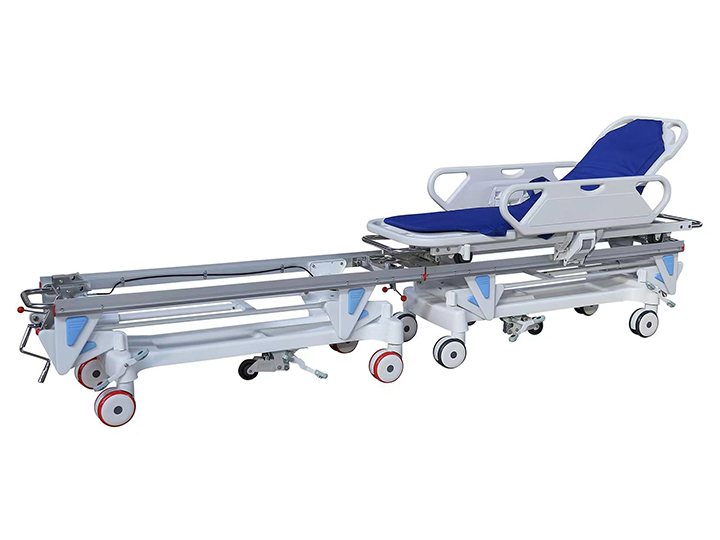
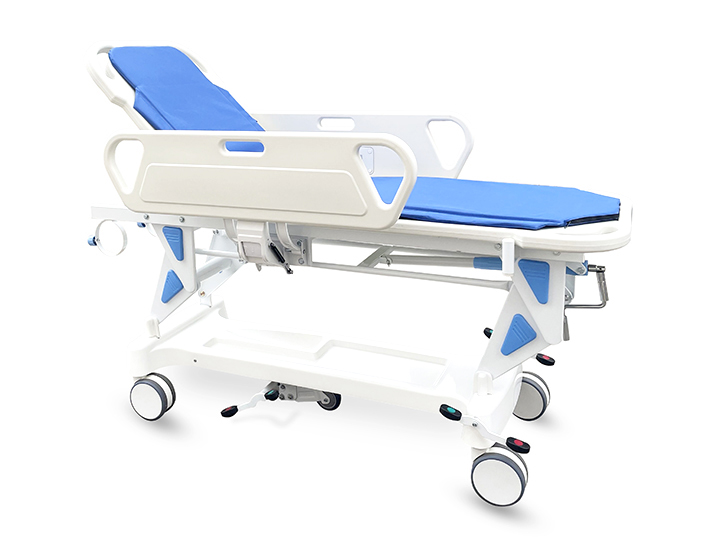
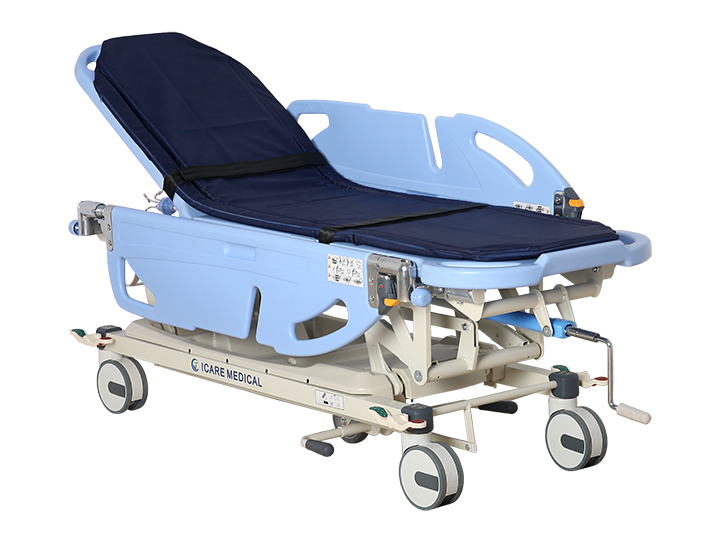
ICARE ships transfer beds out of Wuxi, and the site publishes the range in English, Thai, Indonesian and Vietnamese for those markets. The detail that matters at the table edge is the lift window. The CA-801 runs 540 to 860 mm and the CA-800 covers the same band, while the CA-808 is hand-cranked from 510 to 850 mm and is specified on the site as suitable for bed and operating table height. Those windows are what a scheduler should be checking against the room's fixed working height, because a bed that cannot reach the table's height turns every transfer into a lift.
Wuxi Icare Medical Technology Co., Ltd. does not manufacture operating surfaces, and no surgical table appears in the ICARE catalogue. The catalogue is built around patient surfaces and the trolleys that move them: nursing beds, medical beds, transfer beds, emergency beds and ward furniture. What ICARE supplies to this problem is the docking end: a surface that arrives at the right height, with a backrest that can be set before the slide and a brake that holds while two people move a patient across.
A Sheet for the Next OR Scheduling Meeting
Five numbers to bring, not an opinion
Bring the following to the meeting as measured values rather than estimates. Each one is obtainable in a week from the room log and a stopwatch.
1. Median changeover for same-specialty turns and for cross-specialty turns, measured separately for four weeks.
2. Count of changeovers above 30 minutes, and for each one, whether the delay was table-bound or room-bound.
3. The room's fixed working height, measured at the table with the accessory set mounted, not taken from a brochure.
4. Minutes per day that the table was free while the next patient was ready, with the reason recorded.
5. Number of times per week the transfer bed was unavailable because it was holding a recovering patient.
Item 4 is the number that decides whether a table purchase is justified. If it is under ten minutes per day, a new table buys nothing and the money belongs in the recovery bay or in a second accessory set. If it is over thirty, the constraint is real and the count should rise — but the purchase request should also state the changeover target that the new table is meant to protect, because a table without a turnover plan just adds a third surface to park equipment on.
Recommended News
-
Hospital lift bed selection and usage scenarios
-
Process analysis and practical skills of ward nursing from admission to rehabilitation
-
Functional characteristics and selection of medical diagnosis and treatment examination bed
-
Rehabilitation bed: the key to improving the quality of care for long-term bedridden patients
-
Smart elderly care technology empowers and opens up a new era of elderly care services
-
Function analysis and selection precautions of electric smart bed
-
Guidelines for selecting rehabilitation equipment and analysis of common types
-
Function analysis and selection skills of companion bed
-
New intelligent and community-based development of home-based elderly care
◇◇ Related Content ◇◇
- How Do I Verify The Hospital Bed Factory Before Ordering?
- How Do I Compete With Direct Manufacturer Sales As A Hospital Bed Distributor?
- How Do I Verify The Factory Is Real Before Ordering Hospital Beds?
- What Documents Are Required For Hospital Bed Government Tenders?
- Hospital Bed Government Tender For 200 Beds (Full Guide)
- How Much Does OEM Mold Setup Cost For Hospital Beds?
- Emergency Hospital Bed Order: What "30-Day Delivery" Really Means
- How Long Does OEM Hospital Bed Production Take?
- Hospital Bed Spare Parts Planning: What To Stock For A 50-Bed Fleet