News
News
The Endoscopy Stretcher In A Twelve-case Day
A twelve-case endoscopy list consumes 396 minutes of procedure-room time before anyone counts transport, and the stretcher that serves it spends most of that time parked rather than moving. That ratio is why an endoscopy stretcher is judged by the wrong criteria so often: it is bought as a transport device and used as a moving examination surface, a recovery bay, and a storage rack for an oxygen cylinder over the course of a single morning.
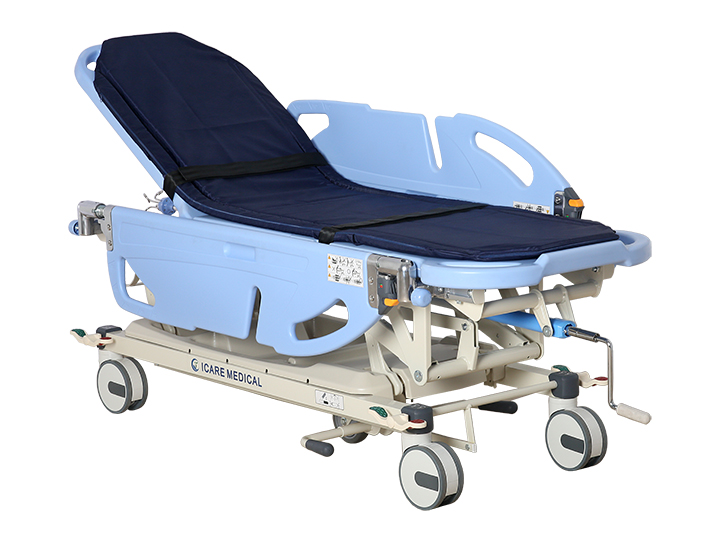
The equipment that carries this load in the ICARE range is CA-808, a 1930 by 663 mm stretcher with a hand-cranked lift from 510 mm to 850 mm and a guardrail system designed around a patient who is sedated rather than cooperative. What follows walks the patient route station by station and checks the hardware against each one, because the failures in an endoscopy unit cluster at the handovers rather than in the procedure room itself.
Why an endoscopy stretcher is a flow tool, not a bed
The five stations that decide the design
Booking, preparation, transport, docking to the examination bed, recovery. Five stations, and the stretcher is the only object present at four of them. A bed that lives in one room can be optimised for that room; a stretcher is optimised for the transitions, and the transitions are where dimensions collide.
Preparation is the first constraint. A sedated patient is prepared on the stretcher, which means the surface has to be cleanable between cases and the backrest has to sit at a working angle for the nurse, not at a lying-flat angle for the transfer. Recovery is the second. A patient waking up occupies the stretcher for longer than the procedure takes, so the count of stretchers is set by recovery dwell time, not by transport speed.
What the narrow outline is really for
At 663 mm wide, CA-808 is roughly 290 mm narrower than the ward beds it collects patients from. That difference is not a compromise on comfort, it is the working clearance in a room where an endoscope tower, a trolley of accessories and two staff all need to be within arm's reach of the patient's head.
The number also decides the route. Against an 800 mm clear door opening the 663 mm outline leaves 68 mm a side; against a 900 mm opening it leaves 118 mm a side. Neither is generous once a wall-mounted hand gel dispenser and a door closer are counted, and the 2041 mm diagonal of the 1930 by 663 footprint means a 90 degree turn needs a junction wide enough for it rather than a corridor bend.
The endoscopy stretcher that carries the day: CA-808 in numbers
Outline and height, measured against the room
The lift is a hand crank over 510 mm to 850 mm, which is a 340 mm band and covers the working height of most examination beds. Check the top of that band against the room rather than against the brochure: an examination bed set at 700 mm leaves 150 mm of stretcher travel above it, at 800 mm the margin is 50 mm, and at 900 mm the stretcher is 50 mm short.
That last case is the one that catches units out, because a raised examination bed is normal when the endoscopist works standing. The fix belongs in the room protocol: bring the bed down to the stretcher, then raise both together if the operator prefers height.
Load: 170 kg safe, 250 kg static
The ICARE CA-808 declares 170 kg safe working load and 250 kg static load. The gap between the two figures is the difference between a patient lying still and a patient arriving with momentum, and it is the number that matters when a bariatric patient is booked into a list that was planned for standard trolleys.
Ask what the safe working load covers. On a stretcher with an oxygen rack, a mattress, an infusion stand and a restraint strap set, the accessories consume part of the allowance before the patient is counted.
The imaging version changes three figures
The imaging variant of CA-808 uses an X-ray translucent deck rated for DR and CT work, a hydraulic foot-pump lift of 540 mm to 880 mm, Trendelenburg at 15 degrees, and a 250 kg rating on a 2150 by 750 mm outline. Three figures move at once: height, width and load.
A unit that plans fluoroscopy in the procedure room should decide this before the order, not after, because the 2150 by 750 mm outline is 87 mm wider and 220 mm longer than the standard unit and will not pass the same doors at the same angle.
Guardrails, oxygen rack and the trays underneath
300 mm rails with a lock the patient cannot reach
The guardrail on CA-808 is 300 mm of PP on both sides with a double safety lock, and the inner side cannot be opened. That detail is the whole point of the design: a sedated patient who becomes restless pushes against the rail, and a rail that opens from the inside is a rail that opens at the worst moment. The same rails swing out horizontally to widen the working surface, which is useful in recovery and hazardous in a corridor.
The rail also carries a drainage tube slot and an angle indicator. The slot keeps a line from being trapped between rail and mattress; the indicator lets a nurse read the backrest angle without guessing, which matters when a report has to state the position a patient was in.
Oxygen on the frame, not on the mattress
The oxygen cylinder rack is horizontal and mounted to the frame, and the standard configuration includes a stainless infusion stand, a mattress and a restraint strap set. Frame mounting keeps a full cylinder off the mattress edge, where it becomes a weight that shifts when the stretcher turns.
There is an infusion stand storage position on the stretcher, and it is the fitting that gets ignored during a busy list. A stand left in its socket at head height clears door frames by a smaller margin than anyone estimates, and a stand that has been laid down and not secured is a projectile in a corridor.
Casters, brakes and the fifth wheel
Four 150 mm casters on a central control, a one-touch brake that locks all four, antistatic conductive wheels and a central fifth wheel with a straight or steer setting. The fifth wheel is the part that changes how the stretcher behaves in a corridor: engaged for the straight run, released for the turn into the procedure room. A unit that never engages it pushes the stretcher like a shopping trolley and blames the casters.
Antistatic wheels belong to a requirement that nobody remembers until a theatre asks for it, so it is worth confirming at the order rather than at the door. Under the deck, the double tray carries drainage holes, which is the difference between a tray that can be wiped and a tray that has to be removed and washed after a leak.
Walking one endoscopy stretcher through a twelve-patient list
The arithmetic of a twelve-patient list
Take twelve patients, 25 minutes of procedure time each and 8 minutes of room turnover. That is 396 minutes, or 6.6 hours, and split across two procedure rooms it is 198 minutes per room.
Now add transport. A run of 9 minutes each way, twice per patient, gives 216 minutes of stretcher occupancy, which is 55 percent of the list length. On that basis a single stretcher looks sufficient, with time to spare.
Where the stretcher count comes from
The spare time disappears once recovery dwell is counted. A patient who stays on the stretcher for 20 minutes while waking, on top of 18 minutes of transport, occupies it for 38 minutes. Twelve patients at 38 minutes is 456 minutes of occupancy against a 396 minute list, a ratio of 1.15, and a ratio above 1 means the list cannot run on one stretcher without a queue forming in the recovery bay.
Two units cover it with room for a delayed wake-up. Three is what a unit buys after its first month of running on two.
| Quantity | Figure used | Source of the figure |
| Patients on the list | 12 | Local list plan |
| Procedure time per patient | 25 minutes | Local list plan |
| Room turnover per patient | 8 minutes | Local list plan |
| Round trip transport | 9 minutes | Measured on the route |
| Recovery dwell on the stretcher | 20 minutes | Local recovery practice |
| Stretcher occupancy per patient | 38 minutes | Transport plus dwell |
| Total list length | 396 minutes | 12 x 33 |
| Occupancy ratio at 38 minutes | 1.15 | 456 divided by 396 |
Two failures that show up between the prep bay and the recovery bay
The rail that was left deployed
The horizontally extending rail is the most useful and most misused feature on the stretcher. Swung out to widen the surface in the prep bay, it stays out through the corridor, and it meets the examination bed's frame before the platforms meet. The stretcher then stops short, the gap has to be bridged, and the bridge is where a sedated patient is most exposed.
The protocol fix costs one sentence: rails out in the bay, rails in before the door. The engineering fix is to check the rail in both positions against the bed it docks to, which takes two minutes with a tape.
The oxygen cylinder that was never strapped
A cylinder placed on a horizontal rack and not secured with the strap travels a few centimetres during a turn and then leans. Nobody notices until the regulator is at an angle, and by then the reading is suspect. The strap is part of the standard configuration for a reason, and the reason is not administrative.
The second version of this failure is the cylinder left on the rack while the patient goes into the procedure room, so the next patient arrives with an empty rack and a full cylinder parked in a corridor.
A walk-through checklist for the endoscopy unit
Nine measurements on the route, taken once
Walk the route with a tape before the order is placed, then repeat the walk with the first unit in the building. The two walks disagree more often than either would suggest.
| Measurement | Where | Why it decides the model |
| Narrowest door on the route | Frame to frame, clear | 663 mm outline leaves 68 mm a side at 800 mm |
| Corridor junction at each turn | Both directions | The 2041 mm diagonal needs a junction, not a bend |
| Examination bed top height | At working height, in each room | Anything above 850 mm is outside the standard lift band |
| Examination bed lowest height | Bed fully down | Sets whether the stretcher must come down or the bed must come up |
| Recovery bay spacing | Between trolley positions | Two units at 663 mm plus access is the real footprint |
| Oxygen cylinder diameter | The cylinders actually stocked | Rack fit is a diameter question, not a brand question |
| Infusion stand clearance | Under each door frame | A stand in its socket is the tallest part of the loaded stretcher |
| Under-bed tray access | With the stretcher at full height | Trays are loaded standing up, not kneeling |
| Floor covering at each threshold | Type and lip height | 150 mm casters cross a lip, not a ramp |
The line depth behind this unit is worth knowing when the walk raises a question the brochure cannot answer. ICARE supplies endoscopy units and theatre suites as a routine part of its transfer bed range, which runs from CA-800 and CA-801 through CA-807 to CA-808, so a question about rail position, rack diameter or tray clearance lands with a team that builds all four rather than with a reseller holding one. Wuxi Icare Medical Technology Co., Ltd. manufactures that range in Binhu District, Wuxi, and a variant request such as a different rack diameter goes through the same drawing process as the standard unit.
Take the nine measurements to the supplier with the list plan attached. A reply that quotes a model number without asking for the examination bed height has not read the route.
Recommended News
-
Hospital lift bed selection and usage scenarios
-
Process analysis and practical skills of ward nursing from admission to rehabilitation
-
Functional characteristics and selection of medical diagnosis and treatment examination bed
-
Rehabilitation bed: the key to improving the quality of care for long-term bedridden patients
-
Smart elderly care technology empowers and opens up a new era of elderly care services
-
Function analysis and selection precautions of electric smart bed
-
Guidelines for selecting rehabilitation equipment and analysis of common types
-
Function analysis and selection skills of companion bed
-
New intelligent and community-based development of home-based elderly care
◇◇ Related Content ◇◇
- How Do I Verify The Hospital Bed Factory Before Ordering?
- How Do I Compete With Direct Manufacturer Sales As A Hospital Bed Distributor?
- How Do I Verify The Factory Is Real Before Ordering Hospital Beds?
- What Documents Are Required For Hospital Bed Government Tenders?
- Hospital Bed Government Tender For 200 Beds (Full Guide)
- How Much Does OEM Mold Setup Cost For Hospital Beds?
- Emergency Hospital Bed Order: What "30-Day Delivery" Really Means
- How Long Does OEM Hospital Bed Production Take?
- Hospital Bed Spare Parts Planning: What To Stock For A 50-Bed Fleet
◇◇ Related Products ◇◇